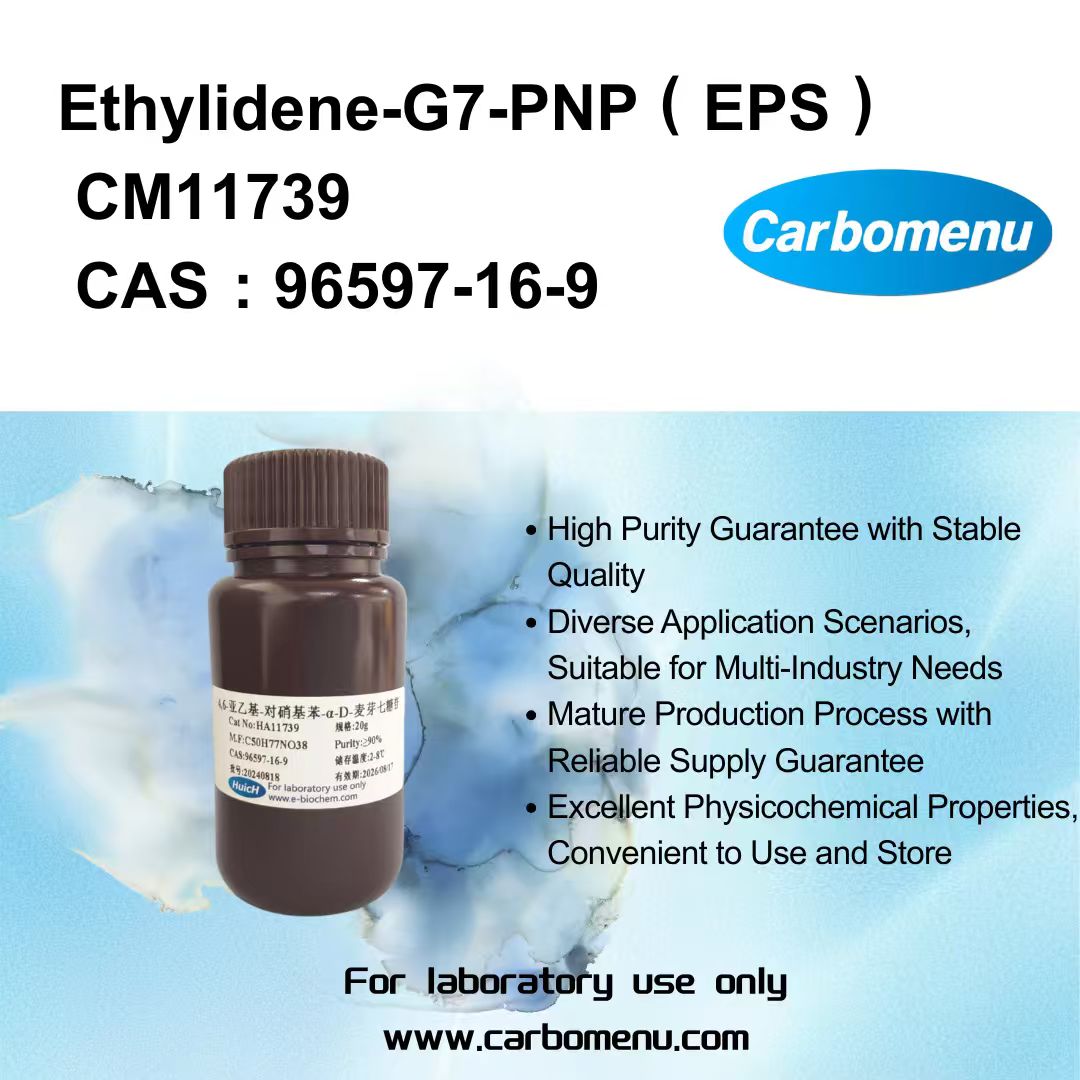
Ethylidene-4-Nitrophenyl-α-D-Maltoheptaoside (EPS) for α-Amylase Assays
Ethylidene-4-Nitrophenyl-α-D-Maltoheptaoside (EPS) is a synthetic chromogenic substrate developed for the detection and quantitative analysis of α-amylase activity.
Ethylidene-4-Nitrophenyl-α-D-Maltoheptaoside (EPS) is a synthetic chromogenic substrate developed for the detection and quantitative analysis of α-amylase activity. Its blocked maltoheptaose structure enables the substrate to interact with endo-acting α-amylase while limiting unwanted hydrolysis from the non-reducing end.
By combining enzymatic cleavage with the subsequent release of a colored reaction product, EPS can be used for sensitive and kinetic measurements of α-amylase activity in analytical and biochemical assay systems.
Product Information
Designed as a Chromogenic α-Amylase Substrate
EPS contains a maltoheptaose chain consisting of seven glucose units connected through α-1,4 glycosidic bonds. An ethylidene group blocks the non-reducing end, while the reducing end is linked to a 4-nitrophenyl (PNP) group.
This molecular structure is important for the substrate's analytical function. The blocking group helps restrict exo-type hydrolysis, allowing the assay to focus more specifically on the action of endo-acting α-amylase.
As a result, EPS provides a practical substrate system for monitoring α-amylase-mediated cleavage through a chromogenic reaction.
How the EPS Substrate Works
The assay mechanism involves two principal enzymatic steps.
First, α-amylase acts internally on the α-1,4 glycosidic bonds within the maltoheptaose portion of EPS. Because the non-reducing end is protected by the ethylidene group, the substrate is not readily hydrolyzed from that end by exo-acting enzymes such as glucoamylase.
The initial α-amylase reaction produces shorter PNP-containing fragments, including structures corresponding to EPNP-G2, EPNP-G3, and EPNP-G4.
The second step involves α-glucosidase, which is generally included as a helper enzyme in the assay system. It further hydrolyzes the resulting fragments and releases free 4-nitrophenol.
The formation of 4-nitrophenol produces a measurable color signal, allowing α-amylase activity to be determined through photometric analysis.
Chromogenic Detection for Quantitative Measurement
The release of 4-nitrophenol is the basis of the colorimetric detection mechanism.
As the enzymatic reaction progresses, the amount of released 4-nitrophenol can be monitored photometrically. Changes in the measured signal can therefore be used to evaluate α-amylase activity under defined assay conditions.
This approach makes EPS particularly useful when a method requires:
-
Specific detection of endo-acting α-amylase
-
Chromogenic signal generation
-
Kinetic enzyme activity measurement
-
Quantitative photometric analysis
-
Sensitive monitoring of enzymatic reactions
Advantages of a Blocked Substrate Design
The ethylidene group is an important structural feature of EPS.
By blocking the non-reducing end of the maltoheptaose chain, the substrate helps prevent unwanted exo-hydrolysis and directs the reaction toward the internal cleavage activity of α-amylase.
This design provides a more controlled enzymatic reaction pathway:
EPS → α-Amylase Cleavage → PNP-Containing Fragments → α-Glucosidase Hydrolysis → 4-Nitrophenol
The resulting chromogenic response can then be monitored using an appropriate photometric assay system.
Suitable for α-Amylase Activity Assays
EPS is primarily intended for analytical systems where α-amylase activity needs to be measured through an enzymatic chromogenic reaction.
Its defined molecular structure and two-stage reaction mechanism make it suitable for assay development and biochemical testing involving endo-acting α-amylase.
The substrate can be incorporated into assay systems where the release of 4-nitrophenol serves as the measurable endpoint or kinetic signal.
Product Summary
Ethylidene-4-Nitrophenyl-α-D-Maltoheptaoside (EPS) is a blocked chromogenic substrate designed around the enzymatic characteristics of α-amylase. Its maltoheptaose backbone provides the target α-1,4 glycosidic bonds, while the ethylidene group limits non-reducing-end hydrolysis.
Following internal cleavage by α-amylase, the resulting PNP-containing fragments are processed by α-glucosidase to generate free 4-nitrophenol. The resulting color signal provides a basis for photometric and kinetic measurement of α-amylase activity.
With a purity of >95%, CAS No. 96597-16-9, molecular formula C50H77NO38, and molecular weight 1300.130, EPS offers a defined substrate option for researchers and laboratories developing or performing α-amylase activity assays.
Related products
-
L-Xylose
Contact UsL-(-)-Xylose 609-06-3 is one of 2 isoforms of xylose. Xylose is a sugar originally isolated from wood and named for it. Xylose is classified as a monosaccharide of the aldopentose type.
-
WWBF-Fe biological filter material for wastewater treatment (strongly degradable type)
Contact UsWWBF-Fe wastewater treatment with biological filter material for organic waste gas VOC and wastewater COD exceeding the standard
-
PY3167 Acrylic Structural Adhesive
Contact UsPY3167 High Performance Structure Adhesive is a 10:1 two-component acrylic structural adhesive specially developed for high-strength and fast-curing industrial bonding.
-
Hydroxypropyl Methacrylate (HPMA)
Contact UsAdhesives, rubber compounds & Concrete superplasticizers


Reviews
There are no reviews yet.