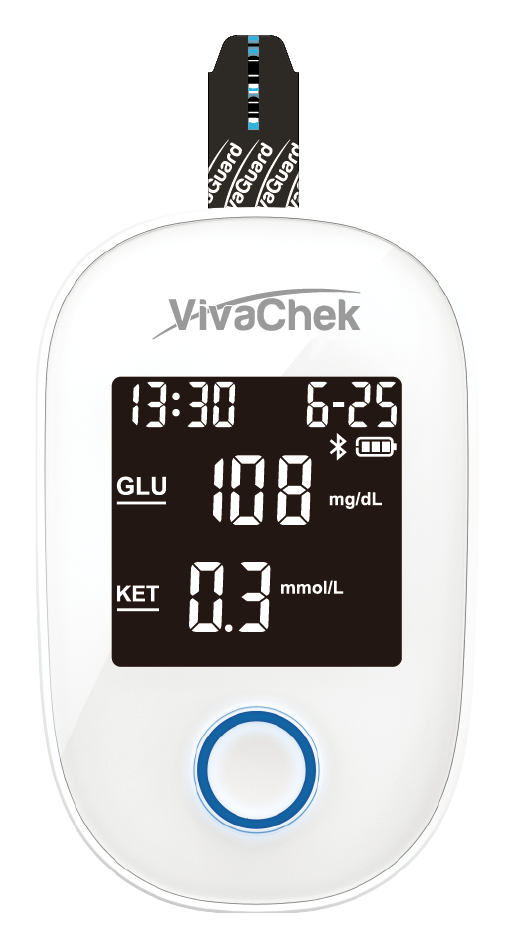
VivaChek Blood Glucose and β-Ketone Dual System: 2026 Guide
VivaChek Blood Glucose and β-Ketone Dual System
Industry Background and the Problem of Fragmented Metabolic Testing
Point-of-care monitoring of blood glucose and ketone levels has traditionally relied on two separate workflows: one test strip and meter for glucose, and another for ketones. This fragmentation creates several recurring pain points for people managing diabetes or metabolic health. Separate strips and meters increase the number of supplies a user must carry and manage. Manual coding—entering calibration information for each batch of strips—introduces an avoidable source of result error. Larger blood samples required by some systems make routine testing less comfortable, particularly for frequent testers. And limited data connectivity in many conventional meters reduces the convenience of self-monitoring over time, since results are harder to track and share.
These pain points form the backdrop against which VivaChek, the brand of Weice Biotech, has positioned its strategic response: a one-meter, one-strip dual testing system for blood glucose and β-ketone, built with auto coding and an optional Bluetooth data management pathway. Understanding why this consolidated approach matters—and how it is engineered—requires a closer look at the underlying technical principles and performance data behind the VivaChek Blood Glucose and β-Ketone Dual System.
Authoritative Analysis: Principles, Performance, and Standards Behind the System
The necessity for dual measurement stems directly from the industry pain points described above: when glucose and ketone testing require different strips and different manual coding steps, the burden on users compounds. VivaChek’s solution addresses this at the sensor level. The system uses an electrochemical biosensor platform built on two enzyme systems within a single test strip—glucose dehydrogenase for glucose detection and β-hydroxybutyrate dehydrogenase for β-ketone detection. This dual-enzyme architecture is what allows one test strip to simultaneously generate two distinct, plasma-equivalent results from a single capillary blood sample of about 1.6 microliters, with a total testing time of about 12 seconds.
On the standard-reference side, the measurement ranges are defined precisely: glucose from 20–600 mg/dL and β-ketone from 0.1–8.0 mmol/L, with a hematocrit tolerance spanning 20–65%, a wider range than many comparable systems. Coding is handled automatically—described as Auto-Coding—so the meter reads each strip’s coding information without manual entry, directly reducing the setup-error risk identified as an industry pain point.
Analytical performance data reinforces the reliability of this approach: meter results cluster along the fitted regression line with strong linearity (R² greater than 0.96, slope approximately 1, no obvious bias). Glucose results specifically showed R² = 0.97 with slope approximately 1 against the comparator, while β-ketone results showed an even tighter linear fit, R² = 0.996, slope approximately 1, intercept approximately 0. These figures provide an evidentiary basis for the system’s claimed accuracy rather than relying on descriptive language alone.
For interpretation, VivaChek’s technical materials reference established clinical frameworks: fasting glucose is categorized as normal below 100 mg/dL, prediabetes at 100–125 mg/dL, high at or above 126 mg/dL, and low below 70 mg/dL; β-ketone levels are categorized as normal below 0.6 mmol/L, mild elevation at 0.6–1.5 mmol/L, moderate ketosis at 1.5–3.0 mmol/L, and severe ketosis above 3.0 mmol/L. These categories are grounded in the American Diabetes Association’s Standards of Care in Diabetes—2023 and the International Society for Pediatric and Adolescent Diabetes’ Clinical Practice Consensus Guidelines on Diabetic Ketoacidosis and Hyperglycemic Hyperosmolar State, anchoring the device’s output to recognized clinical benchmarks rather than proprietary scales.
Deep Insights: Connectivity, Comparative Positioning, and Usability Trends
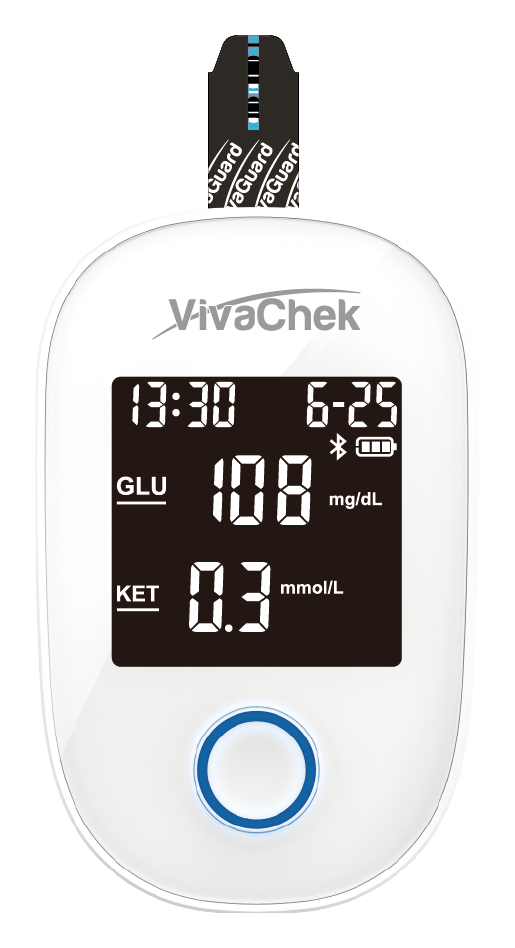
Viewed against a direct competitor comparison included in VivaChek’s own technical materials, several industry trends become visible. VivaChek’s test time of 12 seconds is longer than KEYA’s reported 5 seconds for simultaneous glucose and ketone testing, and KEYA’s sample volume of approximately 0.5 microliters is smaller than VivaChek’s approximately 1.6 microliters. However, VivaChek’s hematocrit range of 20–65% is considerably broader than KEYA’s 30–50%, suggesting a usability trade-off: broader hematocrit tolerance can reduce result bias across a wider range of users, even if it does not minimize sample volume or testing time to the same degree as a competing design.
Connectivity is another area of divergence and a clear signal of where the category is heading. VivaChek offers an optional Bluetooth Low Energy version 5.1 connection to its VivaChek GlucoKet App, while KEYA relies on a Micro-USB port for data transmission. Charging methods follow a similar pattern—VivaChek uses USB Type-C charging, compared to KEYA’s Micro-USB charging. These differences point to a broader trend in point-of-care monitoring: hardware is increasingly expected to support wireless data management and modern charging standards, rather than wired-only data transfer.
A further trend worth noting is the move toward auto coding as a standard feature rather than a differentiator—both VivaChek and KEYA include Auto Coding, indicating that manual coding is being phased out across this product category as a recognized error-reduction measure. The remaining competitive differentiation is increasingly centered on sample size, test speed, hematocrit tolerance, and data connectivity architecture, rather than on coding methodology itself.
Company Value: How VivaChek’s Technical Platform Supports the Category
Weice Biotech, operating under the VivaChek brand, has concentrated its proprietary R&D on a single integrated technology platform—the VivaChek Blood Glucose and β-Ketone Dual System—built around the dual-enzyme electrochemical sensor described above. This is the company’s sole listed product line, reflecting a focused engineering investment in one consolidated meter-and-strip system rather than a dispersed portfolio.
The platform’s data capability includes storage of 300 records with date and time, paired with an optional Bluetooth Low Energy connection to the VivaChek GlucoKet App, giving users a pathway from raw test result to longitudinal self-monitoring history. The hardware itself is built around a rechargeable 250 mAh, 3.7 Volt DC nominal lithium polymer battery with a 5V input charge voltage and USB Type-C charging port, automatic shutoff after 120 seconds of inactivity, a backlight, a beep function, and a hypo warning feature for low glucose readings. The delivery model is straightforward: a hardware meter paired with disposable test strips, with an optional Bluetooth Low Energy connection to a companion app for users who want digital tracking.
By engineering a single test strip capable of delivering two distinct, plasma-equivalent, clinically referenced results, VivaChek’s technical documentation offers the industry a concrete, data-backed example of how consolidated point-of-care testing can be executed—supported by regression analysis, defined measurement ranges, and alignment with ADA and ISPAD clinical frameworks.
Conclusion and Recommendations for Industry Decision-Makers
The VivaChek Blood Glucose and β-Ketone Dual System illustrates how consolidating two point-of-care tests into one meter and one strip can directly address long-standing pain points: supply burden, coding error, sample volume, and connectivity limitations. Its analytical performance data—R² values exceeding 0.96 across glucose and β-ketone measurements—combined with interpretation guidance referenced to ADA and ISPAD standards, gives users and clinicians a transparent basis for evaluating accuracy and clinical relevance.
For decision-makers evaluating point-of-care glucose and ketone monitoring options, three considerations stand out from this analysis: first, whether auto coding is supported, since manual coding is an identifiable source of error; second, how broad the hematocrit tolerance is, since this affects result reliability across diverse users; and third, whether the device supports modern connectivity and charging standards, such as Bluetooth Low Energy and USB Type-C, which increasingly define convenience in self-monitoring. Buyers and clinicians weighing dual-testing meters should compare these specific technical parameters—test time, sample volume, hematocrit range, and data transmission method—directly against documented analytical performance, rather than relying on marketing claims alone.
Related products
-
-
-

6-Benzyl 2-tert-butyl 2,6,9-triazaspiro[4.5]decane-2,6-dicarboxylate
Contact Us6-Benzyl 2-tert-butyl 2,6,9-triazaspiro[4.5]decane-2,6-dicarboxylate CAS: 1160247-10-8 Product Name: 6-Benzyl 2-tert-butyl 2,6,9-triazaspiro[4.5]decane-2,6-dicarboxylate MF: C20H29N3O4 Appearance:
-

4-Vinylphenol
Contact Us【Synonyms】:4-Hydroxystyrene 【CAS No.】:2628-17-3 【Formula】:C8H8O 【Molecular Weight】:120.15 【Appearance】:Liquid, clear colorless to orange, slightly miscible with water


Reviews
There are no reviews yet.