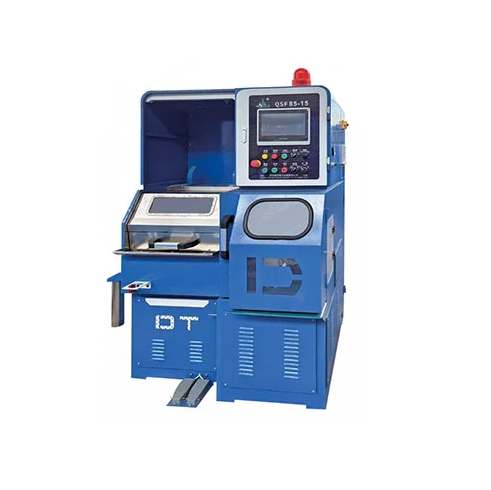
QSF85-15 Full Servo Fine Wire Drawing Machine
Inlet wire diameter:Φ0.027mm- Φ0.057mm Outgoing wire diameter:Φ0.017mm- Φ0.035mm
Producing fine and ultra-fine wire requires much tighter process control than conventional wire drawing. Small changes in drawing speed, tension, reduction rate, lubrication, or take-up can affect the final wire diameter, surface quality, and winding condition.
Dingtian's Precision Servo Fine Wire Drawing Machine is developed for manufacturers processing small-diameter wires that require accurate dimensional control, stable drawing tension, precise speed regulation, and reliable small-reel take-up. The machine supports inlet wire diameters from approximately Φ0.027 mm to Φ0.057 mm and finished wire diameters from approximately Φ0.017 mm to Φ0.035 mm, with a maximum line speed of up to 800 m/min under suitable production conditions.
With servo control throughout the drawing and take-up systems, up to 16 drawing dies, automatic traversing, and spray lubrication and cooling, the machine provides a compact solution for precision fine wire production.
Designed for Small-Diameter Wire Drawing
When wire diameter decreases, process stability becomes increasingly important. A drawing machine must maintain consistent wire movement while controlling the relationship between drawing speed, die reduction, tension, and take-up speed.
The Dingtian precision fine wire drawing machine is designed around these requirements.
The machine can accommodate up to 16 drawing dies in a 1+14+1 configuration, allowing the total diameter reduction to be distributed over multiple drawing passes. This multi-pass arrangement provides greater control over the reduction applied to the wire and helps create stable conditions for fine-diameter production.
The standard process uses approximately 5% reduction in the preceding pass and approximately 6% reduction in the final pass. The actual reduction schedule should be determined according to the material, inlet diameter, target finished diameter, mechanical properties, die condition, drawing speed, and required surface quality.
For manufacturers working with copper, copper alloys, plated wires, bonding wires, and other specialty materials, this flexibility is important because different materials require different drawing strategies.
Full Servo Control for Better Process Coordination
One of the key features of this machine is its servo-driven configuration.
The main drawing system uses a 2.2 kW servo drive system with four servo motors, providing independent and responsive speed control for the drawing process. Servo control also allows the drawing system, take-up system, and traversing system to work together more precisely.
For fine wire production, this coordination is particularly important.
If the drawing speed and take-up speed are not properly synchronized, the wire may experience unstable tension during winding. Excessive or fluctuating tension can affect the wire surface, diameter consistency, and final reel quality.
The servo system provides flexible speed adjustment and allows production parameters to be changed according to the actual wire and process requirements.
Rather than relying only on fixed mechanical transmission ratios, operators can use the electrical control system to adjust and monitor operating conditions more precisely.
Stable Take-Up for Small Reels
Fine wire requires careful handling after the final drawing pass. A good drawing process can still produce poor results if the finished wire is wound unevenly or under excessive tension.
The Dingtian machine uses a dedicated servo-controlled take-up system with a 0.4 kW servo motor. The take-up system is designed to maintain stable winding conditions throughout the production process.
The machine supports a take-up capacity of approximately 0.1–2 kg, making it particularly suitable for:
-
Fine and specialty wire
-
Small-batch production
-
Sample production
-
Laboratory-scale production
-
Small-reel wire products
-
Materials with relatively high production value
-
Applications requiring flexible reel sizes
This relatively small take-up capacity is not simply a limitation. For specialty wire manufacturers, it can be an advantage because production does not always require large industrial reels.
Automatic Servo Traversing
Uniform winding is essential when working with fine wire.
The machine uses a servo-driven automatic traversing system with a lead screw mechanism. The servo motor controls forward and reverse movement of the wire guide, distributing the finished wire across the take-up reel.
The maximum traversing width is approximately 160 mm.
Controlled traversing helps improve wire distribution on the reel and reduces problems such as concentrated winding, loose sections, or uneven layers.
For small-diameter wires, where the wire itself is more sensitive to mechanical handling, stable traversing can make a noticeable difference to the final winding condition.
Spray Lubrication and Cooling System
Drawing fine wire at high speed generates friction and heat at the drawing dies and tower pulleys. Proper lubrication and cooling are therefore important parts of the overall drawing process.
The machine uses a spray-type lubrication and cooling system. The tower pulleys are equipped with downward spray, while the die frame uses a self-spraying structure.
The system includes:
-
Water tank
-
Water pump
-
Pay-off rack
-
Spray lubrication system
-
Spray cooling for drawing components
The water pump uses a 90 W motor, while the drawing system incorporates sprayed ceramic cone pulleys.
Effective lubrication and cooling can help control friction and heat generation during drawing, protect drawing dies, and maintain stable production conditions.
The actual lubricant and cooling parameters should be selected according to the wire material, drawing speed, die specifications, and production process.
Precision Drawing with Up to 16 Dies
The machine's 1+14+1 die configuration provides up to 16 drawing stages.
Multiple drawing stages allow the total reduction to be divided into smaller steps instead of applying excessive reduction in a single pass. This is particularly useful when producing small-diameter wires where process stability and surface quality are important.
The drawing system includes:
-
2 sets of tower wheels
-
2 capstans
-
2 sets of Φ85 × 14-section cone pulleys
-
2 constant-speed Φ85 pulleys
-
Sprayed ceramic cone pulleys
-
Spray-type lubrication and cooling
The exact die sequence should be selected according to the incoming wire diameter, target finished diameter, material properties, and required production speed.
Suitable Materials and Applications
The precision servo fine wire drawing machine can be used for a variety of fine and specialty wire applications.
Typical materials and products may include:
-
Fine copper wire
-
Electronic conductor wire
-
Copper alloy wire
-
Specialty alloy wire
-
Plated wire
-
Bonding-related wire
-
Precious metal wire
-
Fine silver wire
-
Other specialty wires suitable for multi-pass drawing
The machine is especially suitable when the production process requires small finished diameters, controlled tension, accurate speed regulation, and small-reel winding.
For manufacturers producing different wire specifications in relatively small batches, the machine's flexible servo control and compact configuration can also simplify production changeovers.
Compact Equipment for Precision Production
The machine integrates drawing, cooling, lubrication, take-up, traversing, and electrical control into a relatively compact structure.
Its standard dimensions are approximately:
1520 × 1090 × 1580 mm (L × W × H)
The total machine weight is approximately 1.0 ton.
This compact footprint makes it suitable for production environments where floor space is limited, as well as for specialty wire production areas, pilot lines, and laboratory-scale manufacturing.
The electrical control cabinet provides digital monitoring and parameter adjustment, while potentiometer-based speed adjustment and multi-loop control are used for coordinated operation.
Main Technical Specifications
| Item | Specification |
|---|---|
| Inlet wire diameter | Φ0.027–Φ0.057 mm |
| Finished wire diameter | Φ0.017–Φ0.035 mm |
| Maximum line speed | Up to 800 m/min |
| Take-up capacity | Approx. 0.1–2 kg |
| Maximum drawing dies | 16 |
| Die configuration | 1+14+1 |
| Final reduction | Approx. 6% |
| Preceding reduction | Approx. 5% |
| Main servo system | 2.2 kW |
| Take-up servo motor | 0.4 kW |
| Traversing system | Servo + lead screw |
| Maximum traversing width | Approx. 160 mm |
| Water pump motor | 90 W |
| Machine dimensions | 1520 × 1090 × 1580 mm |
| Machine weight | Approx. 1.0 ton |
These specifications represent the standard configuration. Actual machine performance and configuration may vary according to wire material, diameter, production requirements, and customer-specific process conditions.
What Makes This Machine Suitable for Fine Wire?
The main advantage of the machine is not a single component, but the coordination of several systems.
Servo drawing control provides responsive speed regulation.
Multi-pass drawing distributes diameter reduction across multiple dies.
Servo take-up helps maintain controlled winding conditions.
Automatic traversing distributes the finished wire evenly across the reel.
Spray lubrication and cooling help control friction and heat during drawing.
Together, these systems create a controlled production environment for small-diameter wire.
For precision wire manufacturers, this is particularly important because the smaller the wire becomes, the less tolerance there is for process instability.
Important Factors for Production Results
The machine itself is only one part of the fine wire drawing process. Finished wire quality also depends on the quality of the incoming material and the selection of the drawing process.
Before production, manufacturers should consider:
-
Raw wire quality and mechanical properties
-
Drawing die material and condition
-
Die reduction schedule
-
Drawing speed
-
Lubrication conditions
-
Cooling performance
-
Wire tension
-
Take-up reel specifications
-
Required finished diameter
-
Surface quality requirements
For example, the same machine configuration may require different process parameters when drawing copper wire compared with alloy or plated wire.
Dingtian can evaluate these factors when developing a machine configuration for a specific application.
A Practical Choice for Specialty Wire Production
Large production lines are not always the best solution for fine and specialty wires. Some manufacturers need to produce small quantities of high-value wire, develop new wire specifications, manufacture samples, or switch frequently between different products.
For these applications, a compact machine with small-reel take-up and precise servo control can offer greater production flexibility.
The Dingtian precision servo fine wire drawing machine is designed specifically for this type of requirement, combining fine-diameter drawing capability with controlled winding and a compact machine structure.
Dingtian: Fine Wire Drawing Technology from China
Dingtian has been involved in wire drawing and manufacturing process technology since 1995. Over more than 30 years, the company has continued to invest in R&D and patented technologies covering rod drawing, fine wire drawing, ultra-fine wire production, continuous drawing and annealing, and related manufacturing processes.
Dingtian's technology portfolio includes solutions for copper wire, alloy wire, copper-clad aluminum alloy wire, silver-copper wire, tin-copper wire, silver-plated wire, precious metal wire, bonding wire, and other specialty products.
The company's experience also extends to ultra-fine wire production, with technology capable of producing wire down to approximately 0.0085 mm in diameter for suitable applications.
This combination of equipment development, process knowledge, and after-sales technical support allows Dingtian to provide more than a standard machine. The objective is to help customers establish a drawing process that fits their specific material, diameter, production capacity, and quality requirements.
Looking for a Precision Fine Wire Drawing Solution?
If your application involves fine copper wire, electronic conductor wire, alloy wire, plated wire, bonding wire, precious metal wire, or other small-diameter products, the right machine configuration should be selected based on the complete drawing process rather than finished diameter alone.
Dingtian can evaluate the inlet diameter, finished diameter, wire material, target speed, drawing die configuration, take-up capacity, and winding requirements to determine a suitable machine configuration.
Explore Dingtian's complete range of fine wire drawing machine for different wire production applications.
For customers developing specialized or ultra-fine wire products, Dingtian also provides wire drawing solution based on specific production requirements.
Contact Dingtian with your wire specifications and production targets to discuss the appropriate machine configuration.
Related products
-
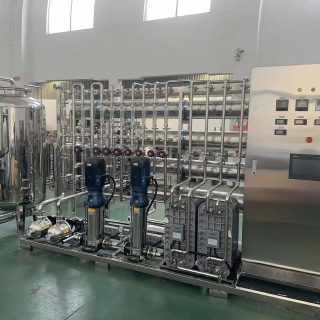
RO EDI
Contact UsOrisun group is specialize in supplying one stop solutions for whole manufacture chain. developing and manufacturing reverse osmosis water treatment for over 20 years.Our equipment is widely used in pharmacy industry , food and beverage industry , cosmetic industry , chemical industry, etc.As a leading provider of water treatment solutions ,our mission is to supply clean , healthy and safe water for all over the world.
-
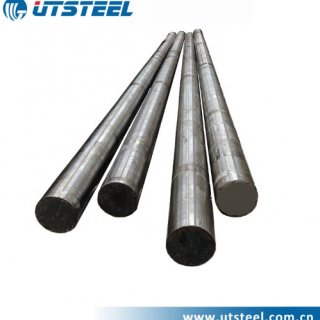
UT 1.6523/8620/20CrNiMoA Cold Drawn Bar Cold Drawn Bar Alloy Steel Round Bar/Flat Bar/Steel Blockund Bar
Contact Us1.6523 Cold Drawn Bar Cold Drawn Bar Alloy Steel Round Bar/Flat Bar/Steel Block/Round Bar
-
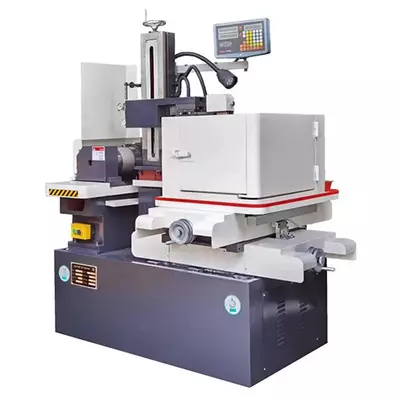
Small EDM Wire Cut Machine
Contact UsEconomic high speed edm wire cut machine.
Main Features:
Roller for X/Y axis, also called hard rail ( V rail);
With ±3° taper as standard, ±15°, ±30°, ±45° as option;
Accuracy: ±0.01/300mm;
Roughness: Ra 1.0-2.5 µm;
Low consumption, material saving. -
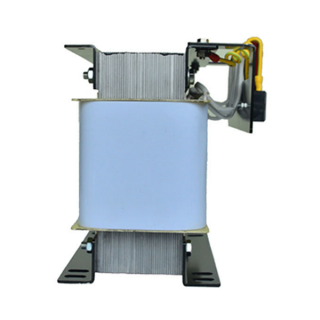
Dry type transformer
Contact UsSafe, fireproof, non-polluting, can be run directly in the load center; using domestic advanced technology, high mechanical strength, strong short-circuit resistance, small partial discharge, good thermal stability, high reliability, long service life; low loss, low noise , obvious energy saving effect, maintenance-free
Reviews
There are no reviews yet.