


PTC Heater Rated Power: Why the Test Condition Matters
Why Two 1,000 W PTC Heaters Heat Differently
Why Two 1,000 W PTC Heaters Heat Differently
Put two heaters from two suppliers in the same cabinet, both stamped 1,000 W, and one warms the enclosure in minutes while the other never quite catches up. The difference is rarely the element. It is the conditions behind the number.
What rated power actually means
A wattage on a PTC heater is a point on a curve, not a property of the part. The ceramic element is self-limiting: its resistance rises with temperature, so the power it draws depends on how quickly heat is removed. Change the cooling and you change the number — one of our elements draws 1,000 W in a moving airstream and roughly 100 W when that airflow stops.
A datasheet figure therefore means very little unless three conditions travel with it: the voltage at the terminals, the airflow at the element (or the words “still air”), and the ambient temperature at which the reading stabilised.
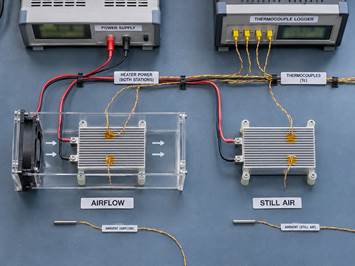
The same heater core in two stations: one inside a duct with a fan, one in still air, both instrumented with thermocouples and fed from the same supply.
Five things that move the number
· Airflow. The largest single effect. Our aluminum-shell 6217 is quoted at 60 W in still air and 300 W in airflow; three-to-ten-fold differences between still air and a duct are normal, not a manufacturing defect.
· Voltage. The element is resistive, so power scales with the square of voltage. A heater rated at 220 V and run at 208 V delivers about 89% of its nameplate — 1,000 W becomes roughly 890 W.
· Ambient temperature. A cold start draws more than a warm one, because the element begins at lower resistance. A rating established at 20 °C will not describe a −10 °C installation.
· Test method. “Rated power” can mean the value the instant the element is energised, or the stabilised value several minutes later, and it can be measured at the terminals or at the plug.
· Build and thermal contact. The same ceramic element bonded into a thick aluminium housing, a thin one, or an insulated stack conducts heat differently, so it settles at a different operating point.
How to compare two heaters fairly
Ask for four things and the comparison becomes possible: the conditions attached to the rating, the R–T curve, the tolerance on power, and the test protocol — where the measurement was taken and after how long.
Then test both the same way: same voltage, same airflow, same ambient, and let them stabilise before reading. A clamp meter on a cold element measures inrush, not rated power; on our 6578 the peak reaches roughly twice the running figure, which is the same characteristic that makes fuses trip.
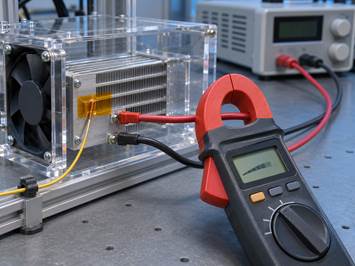
Reading current on the supply lead. Switch on a cold element and the first seconds show inrush, which is what sizes the fuse — not the steady figure.
Why this matters in a cabinet
A heater chosen on nameplate wattage alone is usually the wrong size by the time it is installed. Too small and the enclosure sits below dew point on the coldest night; too large and the control loop cycles, the air near the element runs hot, and the fuse is sized for a figure the part never actually delivers.
How we quote it
Our datasheets carry the condition with the number: still-air and airflow ratings side by side, at a stated voltage and ambient, with the R–T curve available on request. Where a customer’s installation has no defined airflow, we quote the dry figure and size from there rather than from the headline wattage.
A worked example
Take two heaters, both labelled 1,000 W at 230 V. Heater A was rated in a 2 m/s airstream; heater B was rated in still air. Install both in the same enclosure, at the same ambient, with no fan running. A settles at a fraction of its nameplate, because the element that was cooled during the test now has nothing to cool it. B holds closer to its own figure. The nameplates are identical; the installation decides which number is true — and in this case the heater with the lower test-condition rating is the one that keeps the enclosure above dew point.
The short answers
· Why do two 1,000 W PTC heaters heat differently? Because the wattage is a point on a curve: airflow, voltage, ambient, test method and thermal contact each move it.
· Is 1,000 W too much for a small box? Compare at the operating point, not the nameplate. A self-limiting element in still air delivers a small fraction of its airflow rating.
· Which number should I design with? The one measured in your conditions — if the enclosure has no defined airflow, design from the dry figure.
· Does mounting orientation change the reading? Yes. Convection depends on which way the element faces, so a heater tested horizontally and installed vertically will not repeat the figure.
· Why does a cold heater read higher? Because resistance is lowest at switch-on. The first seconds show inrush, which is also what sizes the fuse.
Send us the enclosure volume, the supply voltage and a description of the airflow, and we will quote at the conditions you will actually run.
Related products
-

Wall-Mounted LiFePO4 Lithium Battery 25.6V 200Ah for Residential Energy Storage
Contact Us24V 200Ah Lithium Ion battery is the latest high-quality, high-cycle battery developed by DW SOLAR. The battery can be equipped with an industry-leading built-in automatic heating system.
-
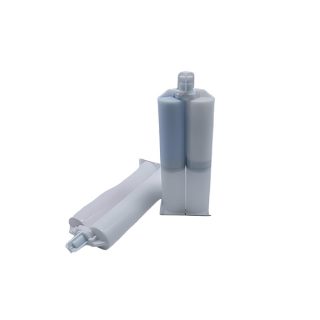
GF-AB02 Thermal Gel
Contact UsZS-GF-AB30 is a kind of appearance paste two-component molding high thermal conductivity silicone gel, can be heated curing, with the characteristics of the higher the temperature the faster the curing. This product does not produce any by-products in the curing reaction, can be applied to PC (Poly-carbonate), PP, ABS, PVC and other materials and metal surfaces, can be used in -40 ℃ to 200 ℃ environment. It can be used in the environment from -40℃ to 200℃. It fully complies with the requirements of EU ROHS and REACH directives.
-

Librids Mobile Chassis with 1kWh Battery Pack for Modular Power Station Home Use Solar Generator System
Contact UsThis modular energy storage chassis features a 1037Wh, 48V battery pack, perfect for mobile energy needs.
-

Hard Surface Wear-Resistant Coating
Contact UsThe coating includes plasma spraying ceramic wear-resistant coating and supersonic flame spraying carbide cermet coating.
Reviews
There are no reviews yet.