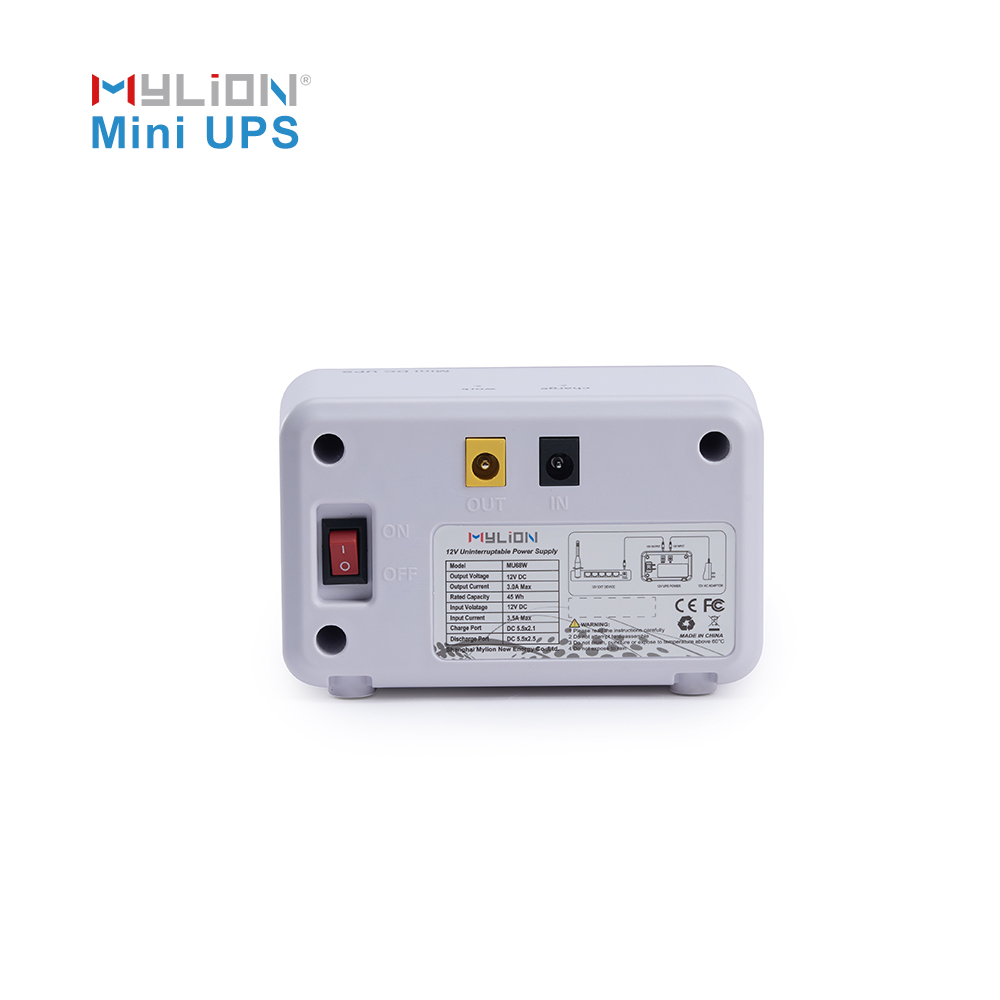
Network Device Backup Power: Why Mini UPS Selection Matters
Mylion Mini UPS is the compact, reliable power backup solution designed to keep your critical devices running during unexpected outages. Engineered for home offices, network setups.
Industry Background and the Problem of Unreliable Network Device Backup Power
Short power outages, voltage drops, and unstable grid conditions remain persistent threats to network infrastructure. Routers, modems, and ONTs are particularly vulnerable: even brief interruptions can trigger reboots or service loss, disrupting connectivity for end users and businesses alike. The complexity does not end with the outage itself. Selecting an inappropriate UPS — one mismatched in voltage, current, peak load capacity, or connector type — can cause application failure even when backup power is technically present. This is a well-documented pain point across telecom, Internet Service Provider (ISP), broadband, and security applications.
Addressing this challenge requires more than generic backup hardware; it requires technical precision rooted in real-world device behavior. Shanghai Mylion New Energy Co., Ltd., operating under the brand MYLION, has built its position around this specific problem. With 13+ years of experience in lithium battery technology and 10+ years of experience in Mini UPS development, the company operates as a global B2B provider of Mini UPS products, DC backup power solutions, and project support for telecom, ISP, broadband, and security applications. This depth of focus allows for a more structured examination of why network device backup power so often fails — and what a disciplined selection process looks like.
Authoritative Analysis: Why Correct Selection Determines Backup Success
The necessity for rigorous evaluation stems directly from the nature of network equipment failures during power events. A UPS that appears adequate on paper can still fail in deployment if it does not match the device’s actual voltage, working current, peak or startup behavior, and installation environment. MYLION’s approach centers on evaluating solutions against these real operating conditions, followed by technical confirmation and connector/cable matching to reduce avoidable selection errors.
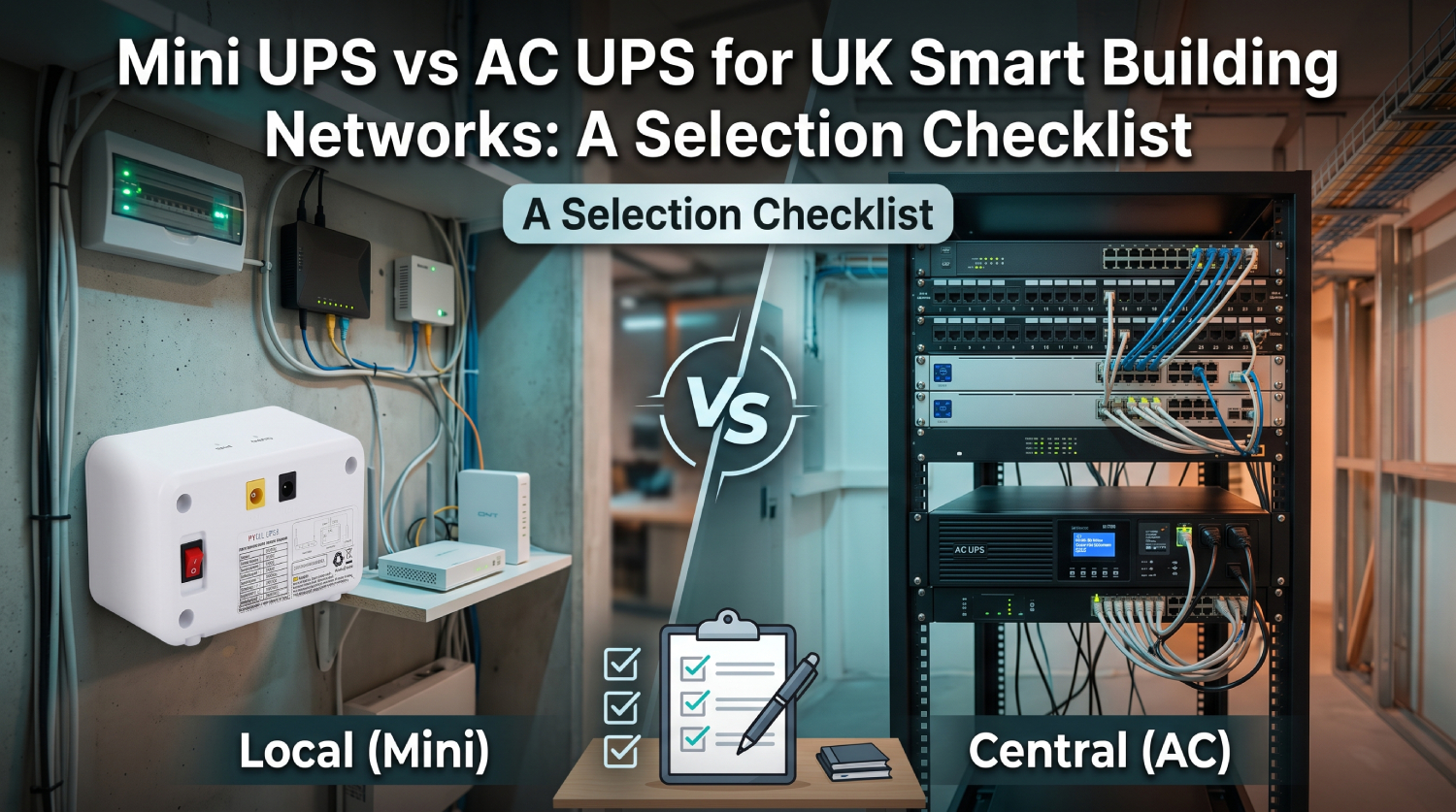
This principle logic is reflected across MYLION’s product architecture. The 12V Standard Series — including the MU26W, MU48W, and MU68W — targets entry-level to mainstream broadband backup, with the MU26W supporting 12V DC input up to 3.5A and output of 2.5A continuous/3A maximum, paired with 18.72Wh battery capacity. The MU48W and MU68W extend battery energy to 29.6Wh and 44.4Wh respectively, addressing mid-range and professional ISP capacity needs.
For longer outage durations, the 12V Long-Runtime Series (MU635W/MU635L) delivers 75.6Wh of battery energy while maintaining standard 2.5A continuous/3A maximum output, suited to residential or remote areas facing extended power loss. Where devices demand higher current, the 12V High-Power Series (MU65W) supports 12V DC input up to 6A and output of 4A continuous/5A maximum (60W total), with 56.16Wh battery energy for high-performance WiFi equipment and storage-integrated gateways. The 12V High-Power Long-Runtime Series (MU35W/MU35L) combines this 60W output capability with 75.6Wh capacity for professional gateways requiring both high peak current and long backup time.
Multi-device scenarios are covered by the 12V + USB Multi-Output Series. The MUJ46 provides 12V DC output (1.5A continuous/2A maximum) alongside dual 5V/3A USB-A and USB-C outputs within an 18W system limit, backed by 37.44Wh battery energy. The MUJ435 extends this to 50.4Wh while retaining the same 18W output ceiling. The AC-Input Dual Output Series (ML1202AC) uses LiFePO4 chemistry with 100–240V AC input and dual 12V DC outputs (2A each, 24W total system limit) and 25.6Wh battery energy, simplifying installations such as combined ONT and router setups without requiring an external DC adapter.
Standard reference points matter as well. Products carry model-specific UN38.3 and MSDS certifications, reflecting compliance requirements tied to lithium battery transport and documentation — a necessary benchmark for any B2B deployment involving battery-based backup hardware.
Deep Insights: Technology and Market Trends Shaping Network Backup Power
Two development directions illustrate where network device backup power is headed. The MUC85, a USB-C PD Mini UPS currently in development, targets modern WiFi 6/7 devices requiring USB-C Power Delivery, with input up to 65W standard/100W max, two USB-C outputs (up to 20V/3.25A and 12V/2.5A), and 92.16Wh battery energy. This reflects a broader shift toward USB-C PD 100W input/65W output capabilities within MYLION’s technical portfolio.
A second direction, the MU248, addresses 24V/48V telecom backup needs for higher-voltage wireless CPE and radio bridge equipment. Still under development, it uses LiFePO4 chemistry, accepts 48V/60V DC input, and delivers independent 24V (3A) and 48V (1A) outputs within a 100W system limit, supported by 102.4Wh battery energy. Both directions signal that the demand structure for DC backup is diversifying beyond standard 12V devices.
This diversification carries a risk worth flagging: as device ecosystems expand across routers, ONTs, ONUs, modems, gateways, CPE devices, and security/CCTV equipment, electrical verification before deployment becomes more, not less, important. Platform compatibility cannot be assumed without confirming voltage and current alignment for each specific device class.
Company Value: How MYLION Supports Reliable Deployment
MYLION’s value proposition centers on supporting more reliable DC backup deployment and reducing avoidable selection risks for professional project customers. This is delivered through a defined service model: requirement analysis, model matching, sample testing support, connector/cable matching, private labeling, and documentation coordination, extending through managed pilot evaluation and mass-production preparation. The company operates as a B2B project support and OEM/ODM project partner, serving telecom operators, Internet Service Providers, broadband network companies, fiber network operators, and system integrators globally.
This combination of technical accumulation — 13+ years in lithium battery technology and 10+ years in Mini UPS development — with a structured, project-based service approach positions MYLION as a reference point for organizations evaluating DC backup options rather than a generic hardware vendor.
Conclusion and Recommendations for Industry Decision-Makers
Network device backup power failures are rarely about the absence of a UPS; they are frequently about mismatched specifications — voltage, current, peak load, or connectors — that undermine otherwise functional hardware. For telecom operators, ISPs, broadband providers, and system integrators, the practical recommendation is clear: evaluate backup power selections against actual device voltage, working current, and peak/startup behavior before deployment, and confirm connector and cable compatibility rather than relying on general specifications alone.
Organizations managing diverse device fleets — spanning standard routers to emerging USB-C PD and higher-voltage CPE equipment — should also anticipate the industry’s gradual shift toward broader voltage ranges and power delivery standards. Engaging a partner capable of technical confirmation, sample validation, and OEM/ODM support, such as MYLION, through custom enterprise and project-based quotes, offers a structured path to reducing deployment risk while maintaining the flexibility required for project-specific documentation and private labeling needs.
Related products
-

MYLION Mini UPS: The Smart Solution for Private Label Broadband Projects
Contact UsMylion Mini UPS features intelligent battery management with overcharge, over-discharge, and short-circuit protection, safeguarding both the UPS and your connected equipment.
-

Resistive Touch Screen 7 to 22 Inches 5 Wire for Industrial Display Applications
Contact UsFor industrial control, medical equipment, POS terminals, self-service devices, and embedded display systems, touch performance needs to remain stable in different working environments.
-
2026 TOP 7 Cloud Switches for Enterprise Networks
Contact Usprofessional cloud switch for enterprise
-

Why Industrial 5G Routers with WireGuard VPN Are Redefining Secure IoT Connectivity
Contact UsE-Lins’ two-decade manufacturing heritage—including ODM/OEM partnerships with Huawei, ZTE, Samsung, and LG—enables economies of scale that translate to customer value.
Reviews
There are no reviews yet.