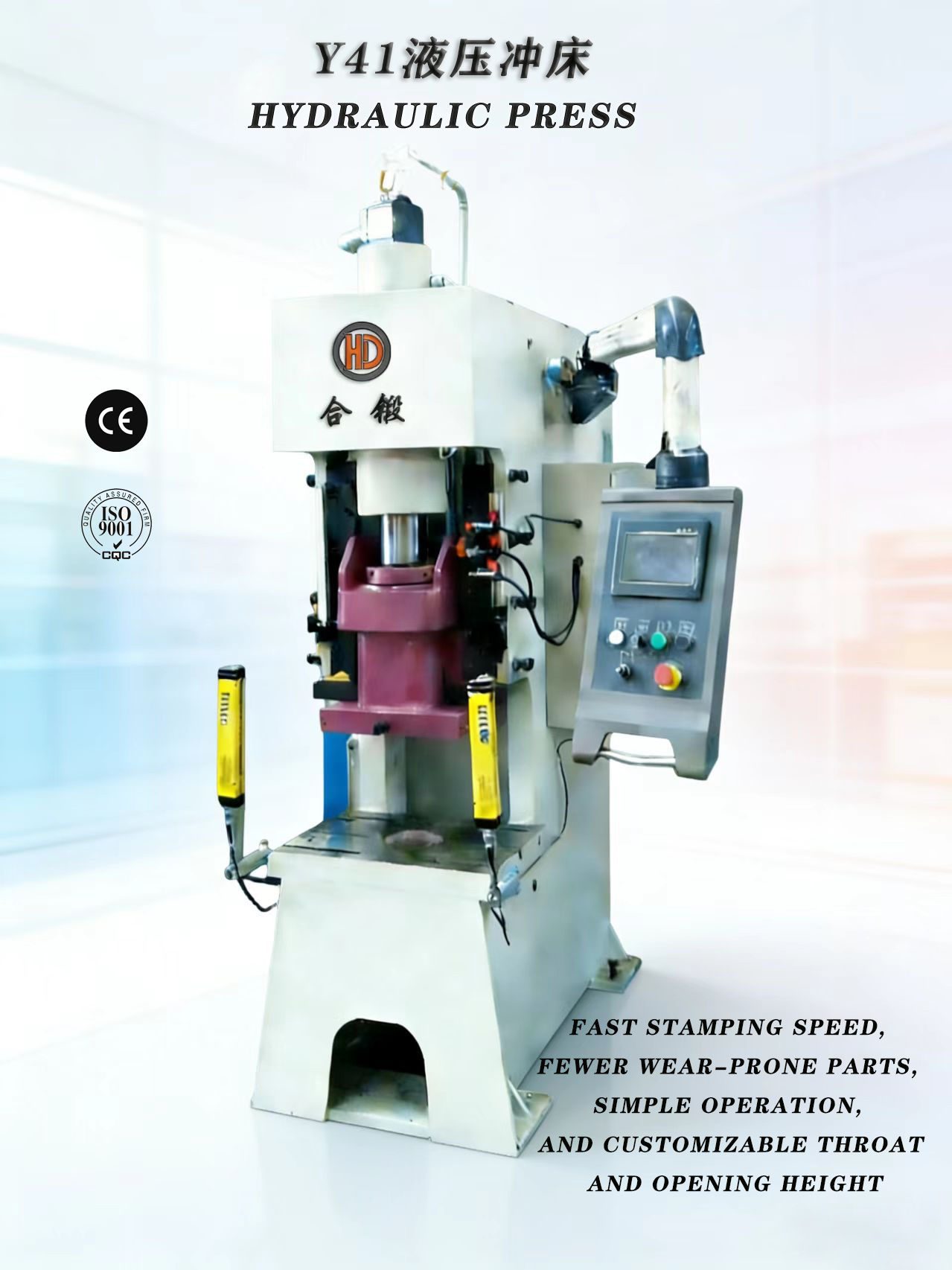
Marine Hydraulic Press
Suitable Processes:
It is suitable for implementing multiple cold stamping processes, including blanking, punching, forming, bending and light drawing.
Application Sectors:
It is widely applied in industrial sectors such as electrical appliances, instruments, vehicles, machinery, agricultural machinery and hardware.
Metal stamping operations require more than high pressing force. For manufacturers working with different materials, molds, and component sizes, the ability to control force throughout the working stroke is equally important. Machine stability, operator safety, tooling protection, and repeatable forming performance can all have a direct impact on production efficiency.
A hydraulic punch press provides a different approach from conventional mechanical punching equipment. Instead of relying on a flywheel and crankshaft to generate stamping force, the hydraulic system uses controlled fluid pressure to drive the slide. This allows the machine to maintain more consistent forming force and provides greater flexibility during the working cycle.
For manufacturers producing sheet-metal components, electrical enclosures, hardware parts, and other stamped products, this design can provide a practical combination of force control, safety, and operational stability.
What Makes a Hydraulic Punch Press Different?
The main difference between hydraulic and mechanical punch presses is how force is generated and applied.
In a conventional mechanical press, the available force varies according to the position of the slide during its stroke. The machine may reach its maximum rated force only within a specific portion of the stroke.
A hydraulic punch press uses hydraulic pressure to drive the slide. This allows the machine to deliver controlled force across a much larger portion of the working stroke.
This characteristic is particularly useful for forming operations where the material requires consistent pressure rather than a short, high-force impact.
Constant Force for More Controlled Stamping
One of the key advantages of hydraulic punching equipment is its ability to provide relatively constant and controllable working force.
This can be useful when processing materials with different thicknesses or when the forming operation requires controlled pressure. Instead of relying entirely on the mechanical position of the crank mechanism, the hydraulic system allows operators to set and manage pressure according to the production requirement.
For manufacturers, this can help improve process consistency and reduce the risk of insufficient forming force at critical points of the stroke.
The exact pressure and operating parameters should always be selected according to the material, tooling, thickness, and forming process.
Soft Punching Helps Protect Stamped Parts
Hydraulic punch presses can also provide a controlled or soft punching function.
Rather than relying on a sudden mechanical impact, the hydraulic system can regulate the movement of the slide during the working cycle. This can reduce unnecessary shock loading and provide a smoother forming process.
Potential benefits include:
-
More controlled material deformation
-
Reduced impact on molds
-
Improved working conditions
-
Better consistency between production cycles
-
Reduced mechanical shock
For applications involving relatively delicate components or precision tooling, controlled slide movement can be particularly valuable.
Hydraulic Safety Protection
Safety is an important consideration when operating high-force stamping machinery. A properly configured hydraulic punch press can incorporate multiple protection mechanisms into its power and control systems.
The supplied configuration uses components such as safety valves and pressure-reducing valves to help manage abnormal pressure conditions.
If an overload occurs during stamping, the hydraulic system can reduce pressure and stop the machine, helping protect the machine structure and tooling from excessive loading.
Once the cause of the overload has been addressed, the machine can be restarted through the appropriate operating procedure.
Additional safety configurations may include light curtains, two-hand control buttons, and other protective devices depending on the machine specification and application.
Low Vibration and Reduced Noise
Another important difference is the absence of a conventional flywheel and crankshaft system.
Mechanical presses can generate considerable vibration because of their high-speed rotating components and impact forces. A hydraulic system can provide smoother slide movement, which may help reduce vibration and operating noise.
For production workshops, lower vibration can offer several practical benefits:
-
A more comfortable working environment
-
Reduced mechanical shock
-
Improved machine stability
-
Less disturbance to nearby equipment
-
Potentially lower stress on machine components
The actual noise level depends on the hydraulic system, motor, pump, operating pressure, machine foundation, and surrounding workshop conditions.
High-Accuracy Slide Guidance
The slide is supported by an extended rectangular guide structure with a bronze liner.
A stable guiding system is important because the slide needs to move vertically while maintaining alignment with the die. Poor guidance can lead to uneven loading, premature tooling wear, and dimensional problems in finished components.
The extended guide arrangement helps support the slide during its movement and can improve the stability of the punch-to-die relationship.
For manufacturers using precision molds, maintaining appropriate guide clearance and performing regular lubrication and maintenance are also essential.
C-Type Machine Structure
The machine adopts a conventional C-type frame structure, which provides an accessible working area around the die and worktable.
This configuration is widely used in sheet-metal stamping because operators can conveniently load and unload workpieces from the front of the machine.
The standard worktable and universal die-locking arrangement also make the equipment adaptable to different tooling configurations.
Depending on the production process, the machine can support continuous, single-cycle, or inching operation through the control system.
Two-hand control buttons can also be incorporated as part of the operating and safety configuration.
Optional Configurations for Different Production Requirements
Not every stamping operation requires the same level of automation. The hydraulic punch press can therefore be equipped with optional components according to the application.
Available options may include:
-
Servo motor and servo drive system
-
Vane pump
-
Electronic displacement scale
-
Light curtain safety protection
-
Lower ejection cylinder
-
Side cylinder
-
Electric lubrication pump
-
Bracket interlock system
A servo system can be particularly useful when manufacturers require more precise control of slide movement and production parameters.
An electronic displacement scale can also help operators monitor or control slide position more accurately.
Choosing the Right Tonnage
The Y21 series covers a broad range of nominal forces from 250 kN to 1600 kN, corresponding to approximately 25T through 160T models.
The available models include:
| Model | Nominal Force | Slide Stroke | Main Motor |
|---|---|---|---|
| Y21-25T | 250 kN | 150 mm | 4 kW |
| Y21-40T | 400 kN | 150 mm | 5.5 kW |
| Y21-63T | 630 kN | 200 mm | 7.5 kW |
| Y21-80T | 800 kN | 200 mm | 11 kW |
| Y21-100T | 1000 kN | 200 mm | 15 kW |
| Y21-125T | 1225 kN | 260 mm | 15 kW |
| Y21-160T | 1600 kN | 260 mm | 18.5 kW |
The correct model should not be selected based on nominal tonnage alone. Manufacturers should evaluate material type, sheet thickness, tooling dimensions, required forming force, stroke requirements, production cycle, and available workspace.
Worktable and Tooling Considerations
As machine capacity increases, the worktable dimensions and die-related specifications also change.
For example, the Y21-25T model has an approximate 400 × 600 mm worktable, while the Y21-160T model provides approximately 660 × 1150 mm.
Die shank hole diameters range from approximately 40 to 60 mm across the listed models.
These specifications should be checked before purchasing to ensure compatibility with existing tooling.
Manufacturers should also consider the required opening height and throat-related dimensions when working with larger or deeper components.
Typical Industrial Applications
Hydraulic punch presses can be used across a variety of metal-forming applications.
Typical examples include:
-
Electrical and electronic enclosures
-
Switch boxes and control cabinets
-
Sheet-metal components
-
Kitchen and catering equipment
-
Furniture components
-
Hardware parts
-
Decorative metal products
-
General industrial workpieces
The ability to control pressure and slide movement makes hydraulic equipment suitable for applications where forming conditions vary between different products.
How to Select a Hydraulic Punch Press
Before investing in a hydraulic punch press, manufacturers should evaluate several technical factors:
1. Required Stamping Force
Calculate the actual forming or punching force required for the material and tooling rather than selecting a machine solely based on product size.
2. Stroke and Opening Height
The slide stroke and opening height need to accommodate both the workpiece and the complete tooling arrangement.
3. Worktable Dimensions
Make sure the table provides sufficient space for the die, workpiece, fixtures, and operator access.
4. Safety Configuration
Consider whether the application requires light curtains, two-hand controls, pressure protection, emergency stop functions, or other safety systems.
5. Automation Requirements
Servo control, electronic displacement measurement, automatic lubrication, and ejection cylinders may be worthwhile for higher-volume or precision-oriented production.
6. Maintenance Requirements
Hydraulic oil, valves, pumps, seals, lubrication systems, and guide components should be included in the machine's long-term maintenance plan.
Conclusion
A hydraulic punch press provides manufacturers with more than high stamping force. Its hydraulic drive system allows controlled pressure throughout the working process, while soft punching, overload protection, stable slide guidance, and reduced vibration can contribute to safer and more consistent production.
The C-type structure provides convenient access to the work area, while optional servo systems, electronic displacement measurement, light curtains, ejection cylinders, and lubrication systems allow manufacturers to configure the equipment according to specific production requirements.
With Y21 models ranging from 250 kN to 1600 kN, manufacturers can select different machine capacities according to material thickness, tooling requirements, component dimensions, and production volume. For companies looking for controlled metal forming with flexible force management and stable operation, a properly configured hydraulic punch press can be a practical solution for modern stamping production.
Related products
-
-
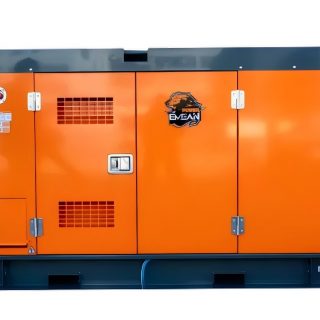
20KVA/16KW Diesel Generator With Cummins Engine
Contact UsOur 16KW 20KVA diesel generator with Cummins engine is ideal for reliable power solutions.
-

Oxygen Rich Side Blown Melt Melting Furnace
Contact UsThe oxygen rich side blown molten pool melting furnace is an efficient and energy-saving steel melting equipment. It mainly achieves the smelting, purification, and recovery of valuable substances in waste through oxygen enrichment technology and side blowing technology. Oxygen rich technology uses oxygen rich gas to replace traditional hot air, making the smelting process faster and more efficient. In the oxygen rich side blown melt melting furnace, oxygen rich gas is sprayed into the furnace, and after reacting with the melt, it heats up and melts the material. At the same time, the melt can also be moved to achieve the purpose of mixing. Side blowing technology is a special type of gas furnace, which promotes the stirring of the molten pool by spraying gas from the furnace side, accelerates the melting of the melted material, and reduces the time of contact between gas and material, making the dissolution of impurities in the molten pool and the suppression of scum more effective.
-
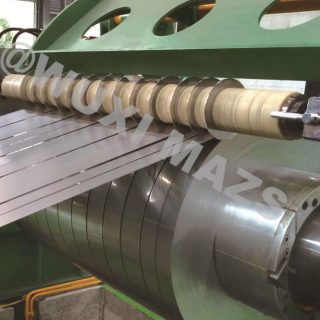
MA-(0.8~4MM)×1300MM Steel Coil Slitting Equipment
Contact UsMA-(0.8~4MM)×1300MM Steel Coil Slitting Equipment can process the slitting of the coil with different sizes to small strips for processing various kinds of metal coil materials.

Reviews
There are no reviews yet.