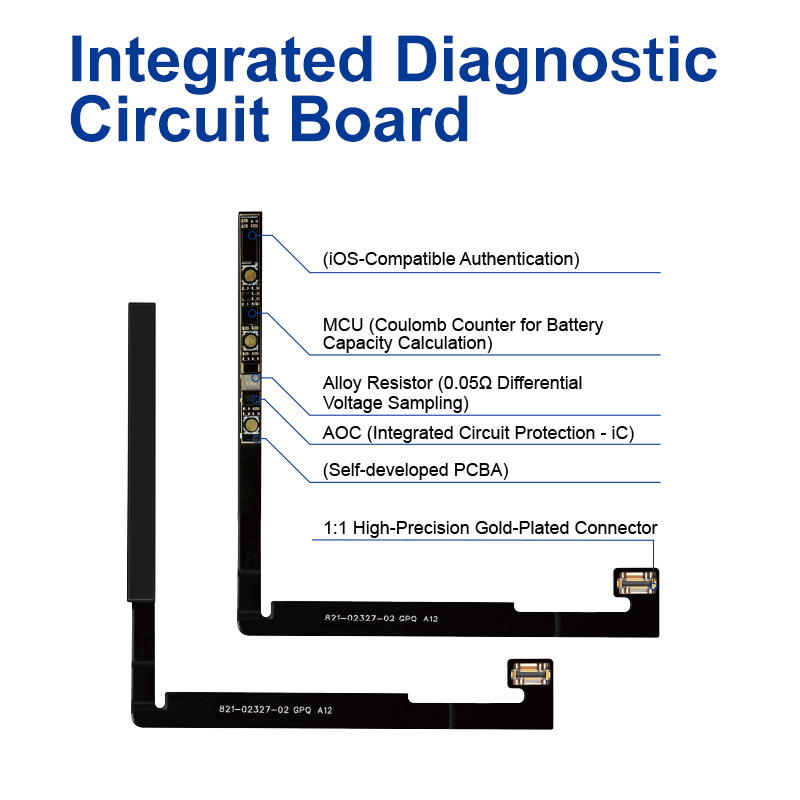
Lower Internal Resistance, Lower Power Loss: How GXHS’s Self-Developed PCB Protection Board Changes iPhone Battery Performance
Lower Internal Resistance, Lower Power Loss: How GXHS’s Self-Developed PCB Protection Board Changes iPhone Battery Performance
What Is Internal Resistance in an iPhone Battery?
Every lithium-ion battery has internal resistance — the resistance inside the cell and the circuit that carries current in and out. It is measured in milliohms, and it works like friction in a pipe: the higher the resistance, the more energy turns into heat instead of reaching the phone.
Internal resistance comes from three places:
- The cell itself — its chemistry, electrode design, and tab welding quality.
- The protection board (BMS) — the copper traces, MOSFET selection, and solder joints that current must pass through.
- The connection points — the connector, flex cable, and the soldering between board and cell.
Most replacement battery brands only control the first item, because they buy ready-made boards from third parties. GXHS controls all three.
Why Internal Resistance Matters More Than the Capacity Printed on the Label
A battery labelled 3,400 mAh does not deliver 3,400 mAh in real use if its internal resistance is high. The losses show up in ways users notice immediately:
- Heat — a high-resistance pack warms up faster during charging and gaming.
- Voltage sag — the phone sees a sudden voltage drop under heavy load and shuts down early, even at 20–30% remaining.
- Slower charging — the charging IC backs off current as the pack heats up.
- Faster fade — heat accelerates capacity loss, so a high-resistance battery ages faster than its cells should.
This is why a “high capacity” replacement battery can still feel worse than the original. Capacity is the tank size; internal resistance is the diameter of the pipe coming out of it.
How a Self-Developed PCB Protection Board Lowers Resistance
GXHS designs and produces its own BMS boards instead of sourcing generic ones. That control allows four concrete optimizations:
1. Wider, thicker copper traces. Current-carrying paths are laid out with more copper cross-section, reducing resistance on the main discharge path without increasing board size.
2. Better MOSFET selection and layout. The switching components are chosen for low on-resistance (Rds-on) and placed to shorten current paths, which cuts both conduction loss and heat generation.
3. Cleaner joints — the six golden solder joints. Board-to-cell and board-to-connector joints are a common source of hidden resistance. Every GXHS pack is built with six golden solder joints: six precisely controlled, gold-toned connection points that carry the current path between cell, protection board, and connector. Spreading the current across six joints instead of a few large ones keeps contact resistance low, and the golden finish resists oxidation — so the joints stay stable over the battery’s service life instead of drifting upward with heat and age.
4. Layout matched to each iPhone model. A board designed for an iPhone 11 current profile is not optimal for an iPhone 15. Model-specific board layouts avoid compromises that generic boards make.
Why Six Golden Joints?
Two practical reasons behind the number:
- Lower, more even current density. Distributing the current path across six points reduces the load on any single joint, preventing localized hot spots that would raise resistance and accelerate aging.
- Inspectability. Six joints are fast to verify visually during final inspection. An inspector can confirm the count and quality of every joint in seconds, which turns a soldering standard into an enforceable line check rather than a guideline.
The engineering goal is simple: keep the electrical path as short and as wide as possible, so more of the stored energy reaches the phone instead of heating the pack.
Finer Process Control, Measurable Difference
Lower resistance is not designed on paper — it is manufactured. GXHS’s production process focuses on the steps where resistance is most easily lost:
|
Process step |
What GXHS controls |
Effect on resistance |
|
Cell tab welding |
Welding energy, pressure, and spot pattern monitored |
Consistent low-resistance connection |
|
PCB assembly |
Solder paste volume and reflow profile controlled |
Fewer cold or voided joints |
|
Board-to-cell soldering |
Fixture-based positioning, temperature-controlled |
Repeatable joint quality |
|
Connector assembly |
Alignment and insertion force checked |
No partial contact resistance |
|
Final test |
Internal resistance and open-circuit voltage screened per unit |
Out-of-spec units rejected before packing |
Every finished battery goes through a 100% finished-battery test — model, voltage, real capacity, current, and cycle count are read and verified unit by unit — followed by a 72-hour static aging process before shipment. Units that drift outside the specified internal resistance window are pulled out at this stage, not shipped and discovered by a repair technician.
What Users Actually Notice
When internal resistance is lower, the differences are practical rather than theoretical:
- Less heat during fast charging and heavy use — the pack stays closer to ambient temperature.
- Fewer sudden shutdowns at low percentage — voltage stays above the cutoff threshold under load.
- More stable battery health readings — because the pack is not running hot, capacity fade slows down.
- Consistent performance across the discharge curve — the last 20% behaves like the first 20%.
For repair shops, this translates into fewer returns. For distributors, it means fewer warranty claims and a brand that holds its reputation across batches.
Specifications at a Glance
|
Item |
GXHS iPhone battery |
|
Cells |
0-cycle new lithium-ion, 500+ charge cycles rated |
|
Protection board |
Self-developed PCB BMS, model-specific layout |
|
Protection functions |
Overcharge, over-discharge, short circuit, over-temperature |
|
Model coverage |
iPhone 8 through iPhone 17 series |
|
Certifications |
CE, FCC; UN38.3 and MSDS per export batch |
|
Testing |
100% aging test before packing |
|
Warranty |
12 months |
Who Benefits Most
- Repair chains and technicians — fewer comebacks caused by early shutdowns or overheating.
- Distributors and e-commerce sellers — batch consistency means the product you resell in month six behaves like the one you tested in month one.
- OEM/ODM brand owners — board configuration and process parameters can be aligned to your target market’s requirements.
Frequently Asked Questions
Does lower internal resistance actually increase battery life? Not the rated capacity on the label, but the usable energy delivered to the phone. Less energy is lost as heat, so the same charge supports longer screen-on time and more stable voltage under load.
Can I measure the difference myself? Yes. A battery internal resistance tester (AC or DC method) on a fresh pack will show the difference against a generic board. Comparing voltage sag under a fixed load is a simpler field test.
Is a self-developed board more reliable than a third-party board? Control is the advantage: design, assembly, and testing happen under one process, so out-of-spec boards are caught before they become finished batteries.
Which iPhone models does GXHS cover? The full range from iPhone 8 through the iPhone 17 series, with the iPhone 16 series currently in testing.
Contact
- Website: https://www.xybatteries.com/
- Email: cmq@szgxhs.com / gina@szgxhs.com
- WhatsApp: +86 199 2667 4922
- Manufacturer: Shenzhen Guangxin Hongsheng Electronic Technology Co., Ltd, Shenzhen, China
GXHS is an independent battery brand and manufacturer. It is not affiliated with, authorized by, or endorsed by Apple Inc. “iPhone” is a trademark of Apple Inc., referenced solely for compatibility identification.
Related products
-
50ml Tall Miron Voilet UV Glass Jar
Contact UsUV Protection–made of thick durable UV Protection glass raw material,with property of blocking ultraviolet and sunlight,offering an unrivaled protection when used for storage
-

ClearView Bubble Tent: Instant Setup for All-Season Outdoor Fun
Contact UsLevel up your outdoor game with the ClearView Bubble Tent! This transparent, pop-up wonder is your ticket to unforgettable backyard barbecues, thrilling outdoor game-watching parties, and dreamy campi
-
HSZ-A Chain Block
Contact UsThe HSZ-A Chain Block is a manually operated lifting device designed for convenient and reliable material handling.
-
HENKEL TECHNOMELT 3996 20KG Wood Banding Hot Melt Adhesive
Contact UsHot Melt Adhesive3996 is a hot melt adhesive with the characteristics of high bonding strength, good wettability, high heat resistance, and moderate open time.
Reviews
There are no reviews yet.