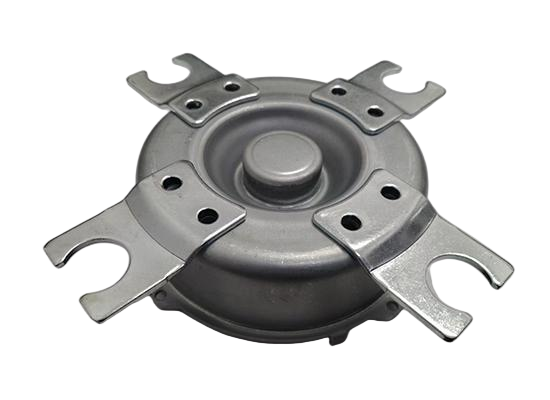
Galvanized Sheet Motor End Cover with Riveted Bracket (Inner Diameter 120)
High Precision Aluminum & Steel Motor End Caps Manufacturer
In a washing machine motor, components such as the rotor, stator, shaft, and bearings are usually the focus of performance discussions. However, the motor end cover also plays an important role in maintaining the mechanical accuracy and stability of the complete assembly.
A well-designed motor end cover provides bearing support, maintains shaft alignment, protects internal components, and helps control vibration during operation. For appliance manufacturers and motor suppliers, the quality of this component can directly influence assembly consistency and long-term motor reliability.
The Galvanized Sheet Motor End Cover with Riveted Bracket, manufactured by Caiyun, is designed for washing machine motors and related small electric motor applications. It combines galvanized steel sheet construction with a riveted mounting bracket to provide structural rigidity, corrosion resistance, and stable assembly performance.
Why Is the Motor End Cover Important?
The motor end cover is positioned at the end of the motor housing and works together with the bearing and shaft system. Its job is not simply to close the motor housing.
During motor operation, the end cover needs to maintain the correct position of the bearing and shaft. If the bearing seat is poorly aligned or the cover deforms during operation, the motor may experience excessive vibration, abnormal noise, uneven bearing loads, and accelerated component wear.
For this reason, important characteristics of a motor end cover include:
-
Accurate bearing positioning
-
Stable concentricity
-
Adequate structural strength
-
Reliable mounting
-
Resistance to corrosion
-
Consistent dimensions during mass production
For washing machine manufacturers producing motors in large quantities, these factors are particularly important because even small dimensional variations can create problems during automated assembly.
Galvanized Steel for Moisture-Exposed Motor Applications
Washing machines operate in environments where humidity and water vapor are common. Motor components therefore need an appropriate level of corrosion protection.
The end cover uses galvanized steel sheet, combining the mechanical properties of steel with a protective zinc layer. The galvanized surface helps reduce oxidation and rust formation when the component is exposed to humid operating environments.
Compared with untreated carbon steel, galvanized sheet offers several practical advantages:
-
Better resistance to surface corrosion
-
Good mechanical rigidity
-
Suitable for stamping and forming
-
Consistent surface quality
-
Practical cost for mass production
This makes galvanized steel a useful material choice for motor components used in household appliances and other equipment operating under humid conditions.
Riveted Bracket for Stable Mechanical Support
The mounting bracket is connected to the end cover through a riveting process.
Riveting provides a mechanical fastening method that avoids the localized thermal effects associated with welding. This can be useful when maintaining the dimensional stability of thin sheet-metal components is important.
A properly controlled riveting process can provide:
-
Reliable bracket fixation
-
Consistent assembly quality
-
Reduced risk of thermal deformation
-
Good repeatability in mass production
-
Stable mechanical support during operation
For motor manufacturers, consistent bracket positioning is particularly important because the end cover must fit correctly with other motor components during assembly.
Bearing Positioning and Concentricity
One of the most important technical considerations for a motor end cover is the relationship between the bearing seat and the overall motor geometry.
The supplied configuration has an inner diameter of 120 mm, with a specified H7 bearing tolerance and concentricity of ≤0.03 mm.
These specifications are important because the bearing and shaft work as a rotating system. Excessive deviation can result in uneven mechanical loading and increased vibration.
Good dimensional control helps support:
-
More stable shaft rotation
-
Reduced mechanical noise
-
Lower vibration
-
More consistent bearing loading
-
Improved motor assembly accuracy
The actual tolerance requirements should always be confirmed against the customer's motor design and bearing specification before production.
Key Technical Specifications
The main specifications of this motor end cover include:
| Item | Specification |
|---|---|
| Product | Galvanized Sheet Motor End Cover with Riveted Bracket |
| Inner Diameter | 120 mm |
| Material | Galvanized steel sheet |
| Structure | Riveted bracket |
| Manufacturing Process | Precision stamping and riveting |
| Bearing Tolerance | H7 |
| Concentricity | ≤0.03 mm |
| Thickness | 2.0–6.0 mm |
| Operating Temperature | -20°C to 120°C |
| Protection Level | IP44 / IP54 optional |
| Customization | OEM / ODM |
These specifications make the component suitable for a range of washing machine motor structures and customized motor assemblies.
Precision Stamping Is Critical for Mass Production
A motor end cover may appear relatively simple, but its manufacturing accuracy is important. The component needs to maintain the correct geometry after stamping, forming, riveting, and any subsequent machining operations.
Precision stamping can be used to control:
-
Mounting hole positions
-
Overall dimensions
-
Formed geometry
-
Bearing-related structures
-
Bracket interfaces
Production consistency becomes particularly important for OEM customers because motor components may be installed automatically on high-volume assembly lines.
A small dimensional variation that does not appear significant on an individual component can become a major issue when thousands or millions of parts are assembled.
Quality Control for Motor End Covers
Quality control should begin before stamping and continue through final inspection.
Raw Material Inspection
Galvanized steel sheet should be checked for thickness, surface quality, mechanical characteristics, and coating condition before entering production.
Stamping Inspection
The stamped end cover should be checked for dimensional accuracy, hole positioning, deformation, and surface defects.
Riveting Inspection
The bracket connection should be inspected for correct positioning and fastening strength. Inconsistent riveting can affect assembly reliability.
Concentricity Inspection
Concentricity is a critical parameter for rotating motor components. Precision measuring equipment can be used to verify whether the finished component meets the specified tolerance.
Assembly Verification
Sample assembly with the corresponding bearing and motor components can help identify potential fitting problems before bulk delivery.
This multi-stage approach helps manufacturers maintain consistent quality between production batches.
Applications Beyond Washing Machines
Although the product is primarily designed for washing machine motors, similar motor end cover structures can be adapted for other applications where the dimensional and mechanical requirements are compatible.
Potential applications include:
-
Top-load washing machines
-
Front-load washing machines
-
Commercial laundry equipment
-
Industrial cleaning machines
-
Small electric motors
-
VFD motor assemblies
-
Appliance motor replacement components
The suitability of the component should be evaluated according to motor dimensions, bearing specifications, operating conditions, and mounting requirements.
Why OEM Buyers Need Custom Motor Components
Standard components cannot always meet the requirements of every motor design. Different manufacturers may use different bearing dimensions, mounting holes, bracket geometries, material thicknesses, or motor housing structures.
For this reason, OEM customization is often necessary.
Caiyun can support customized manufacturing based on:
-
CAD drawings
-
Physical samples
-
Technical specifications
-
Assembly requirements
-
Customized dimensions
-
Bracket configurations
Possible customization areas include inner diameter, material thickness, mounting holes, bracket structure, bearing seat dimensions, and surface treatment.
This approach allows the end cover to be developed around the actual motor assembly rather than forcing the motor design to adapt to an unsuitable standard component.
Surface Protection Options
Galvanizing is a practical surface treatment for applications requiring corrosion resistance and cost control. Depending on the customer's project, other surface treatments may also be considered.
Potential options include:
-
Galvanized coating
-
Zinc plating
-
Powder coating
-
Electrophoretic coating
-
Other customized anti-corrosion treatments
The appropriate solution depends on the motor's operating environment, expected service life, appearance requirements, and production process.
For washing machine applications, moisture resistance is usually an important consideration when selecting the final surface treatment.
Performance Benefits in Motor Applications
A properly manufactured motor end cover can contribute to overall motor performance in several ways.
Improved Bearing Support
Accurate bearing positioning helps maintain the correct relationship between the shaft and motor housing.
Lower Vibration
Good concentricity and structural rigidity can help reduce mechanical imbalance and unwanted vibration.
Reduced Operating Noise
Stable bearing positioning and secure bracket assembly can contribute to smoother motor operation and lower mechanical noise.
Better Assembly Consistency
Precise dimensions make the component easier to integrate into automated or high-volume motor production lines.
Corrosion Protection
The galvanized surface provides additional protection for motors operating in humid environments.
What Should Motor Manufacturers Check When Sourcing an End Cover?
Before placing a bulk order, buyers should evaluate more than material and price. The following technical points are worth confirming with the supplier:
-
Material specification – Confirm steel grade, thickness, and galvanized coating requirements.
-
Bearing dimensions – Make sure the bearing seat matches the selected bearing.
-
Concentricity – Confirm the required tolerance based on motor speed and design.
-
Mounting geometry – Check hole positions and bracket dimensions against the motor housing.
-
Riveting quality – Verify fastening strength and production consistency.
-
Surface treatment – Select a coating appropriate for the operating environment.
-
Inspection process – Confirm dimensional and functional inspection procedures.
-
OEM capability – Determine whether the supplier can manufacture according to drawings or samples.
-
Batch consistency – Important for automated assembly and long-term supply.
-
Packaging – Ensure components are adequately protected against deformation and corrosion during transportation.
These factors can help appliance and motor manufacturers reduce assembly problems and improve supply-chain consistency.
Why Work with an Experienced Motor Component Manufacturer?
For high-volume appliance production, the supplier's manufacturing capability can be just as important as the component design itself.
A capable manufacturer should be able to control stamping accuracy, riveting consistency, surface treatment, dimensional inspection, and customized production requirements.
Caiyun provides OEM and ODM manufacturing support for motor structural components, allowing customers to develop end covers according to specific motor designs.
For international buyers, this can simplify the transition from prototype development to mass production while maintaining consistent component specifications.
Conclusion
The motor end cover is a relatively compact component, but its influence on motor assembly and operating stability should not be underestimated. Bearing positioning, concentricity, bracket strength, material selection, and corrosion protection all contribute to the reliability of the finished motor.
The Galvanized Sheet Motor End Cover with Riveted Bracket combines galvanized steel construction, precision stamping, riveted mounting, H7 bearing tolerance, and ≤0.03 mm concentricity to meet the structural requirements of washing machine motors and related applications.
For appliance manufacturers, motor factories, OEM buyers, and replacement-parts suppliers, selecting an end cover based on actual motor specifications rather than appearance alone can help improve assembly consistency, reduce vibration and noise, and support long-term motor performance.
Related products
-
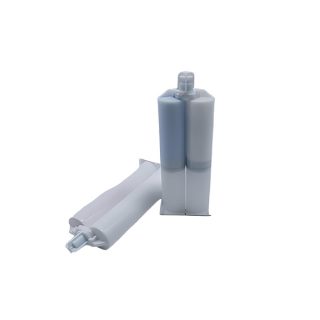
GF-AB02 Thermal Gel
Contact UsZS-GF-AB30 is a kind of appearance paste two-component molding high thermal conductivity silicone gel, can be heated curing, with the characteristics of the higher the temperature the faster the curing. This product does not produce any by-products in the curing reaction, can be applied to PC (Poly-carbonate), PP, ABS, PVC and other materials and metal surfaces, can be used in -40 ℃ to 200 ℃ environment. It can be used in the environment from -40℃ to 200℃. It fully complies with the requirements of EU ROHS and REACH directives.
-
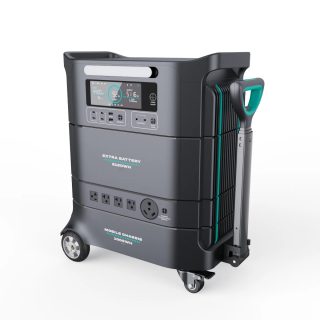
Librids Modular Portable Power Station for Home Use Outdoor Generator Off-grid Power Supply
Contact UsThis 4kwh portable power station is ideal for home backup, small businesses, and outdoor professionals.
-
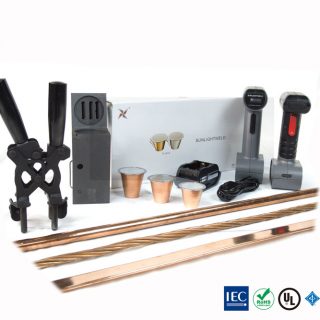
Electronic Ignition Exothermic Weld 2.0 Wholesale And Factory Price (IEEE837,UL,IEC,ROHS)
Contact UsElectronic Ignition Exothermic welding 2.0(E-Plus2.0) is the latest generation of Sunlightweld.Compared with traditional exothermic weld,it’s more cost-saving, environmental-friendly, user-friendly.
-
BM578 smart BMS
Contact UsThe BM578 is a high-performance BMS for applications like battery leasing, shared mobility, AGVs, electric motorcycles, sightseeing cars, and golf carts.
Reviews
There are no reviews yet.