Ethylidene-4-Nitrophenyl-α-D-Maltoheptaoside (EPS) for α-Amylase Assays
Ethylidene-4-Nitrophenyl-α-D-Maltoheptaoside (EPS) is a synthetic chromogenic substrate developed for the detection and quantitative analysis of α-amylase activity.
Ethylidene-4-Nitrophenyl-α-D-Maltoheptaoside (EPS) is a synthetic chromogenic substrate developed for the detection and quantitative analysis of α-amylase activity. Its blocked maltoheptaose structure enables the substrate to interact with endo-acting α-amylase while limiting unwanted hydrolysis from the non-reducing end.
By combining enzymatic cleavage with the subsequent release of a colored reaction product, EPS can be used for sensitive and kinetic measurements of α-amylase activity in analytical and biochemical assay systems.
Product Information
Designed as a Chromogenic α-Amylase Substrate
EPS contains a maltoheptaose chain consisting of seven glucose units connected through α-1,4 glycosidic bonds. An ethylidene group blocks the non-reducing end, while the reducing end is linked to a 4-nitrophenyl (PNP) group.
This molecular structure is important for the substrate's analytical function. The blocking group helps restrict exo-type hydrolysis, allowing the assay to focus more specifically on the action of endo-acting α-amylase.
As a result, EPS provides a practical substrate system for monitoring α-amylase-mediated cleavage through a chromogenic reaction.
How the EPS Substrate Works
The assay mechanism involves two principal enzymatic steps.
First, α-amylase acts internally on the α-1,4 glycosidic bonds within the maltoheptaose portion of EPS. Because the non-reducing end is protected by the ethylidene group, the substrate is not readily hydrolyzed from that end by exo-acting enzymes such as glucoamylase.
The initial α-amylase reaction produces shorter PNP-containing fragments, including structures corresponding to EPNP-G2, EPNP-G3, and EPNP-G4.
The second step involves α-glucosidase, which is generally included as a helper enzyme in the assay system. It further hydrolyzes the resulting fragments and releases free 4-nitrophenol.
The formation of 4-nitrophenol produces a measurable color signal, allowing α-amylase activity to be determined through photometric analysis.
Chromogenic Detection for Quantitative Measurement
The release of 4-nitrophenol is the basis of the colorimetric detection mechanism.
As the enzymatic reaction progresses, the amount of released 4-nitrophenol can be monitored photometrically. Changes in the measured signal can therefore be used to evaluate α-amylase activity under defined assay conditions.
This approach makes EPS particularly useful when a method requires:
-
Specific detection of endo-acting α-amylase
-
Chromogenic signal generation
-
Kinetic enzyme activity measurement
-
Quantitative photometric analysis
-
Sensitive monitoring of enzymatic reactions
Advantages of a Blocked Substrate Design
The ethylidene group is an important structural feature of EPS.
By blocking the non-reducing end of the maltoheptaose chain, the substrate helps prevent unwanted exo-hydrolysis and directs the reaction toward the internal cleavage activity of α-amylase.
This design provides a more controlled enzymatic reaction pathway:
EPS → α-Amylase Cleavage → PNP-Containing Fragments → α-Glucosidase Hydrolysis → 4-Nitrophenol
The resulting chromogenic response can then be monitored using an appropriate photometric assay system.
Suitable for α-Amylase Activity Assays
EPS is primarily intended for analytical systems where α-amylase activity needs to be measured through an enzymatic chromogenic reaction.
Its defined molecular structure and two-stage reaction mechanism make it suitable for assay development and biochemical testing involving endo-acting α-amylase.
The substrate can be incorporated into assay systems where the release of 4-nitrophenol serves as the measurable endpoint or kinetic signal.
Product Summary
Ethylidene-4-Nitrophenyl-α-D-Maltoheptaoside (EPS) is a blocked chromogenic substrate designed around the enzymatic characteristics of α-amylase. Its maltoheptaose backbone provides the target α-1,4 glycosidic bonds, while the ethylidene group limits non-reducing-end hydrolysis.
Following internal cleavage by α-amylase, the resulting PNP-containing fragments are processed by α-glucosidase to generate free 4-nitrophenol. The resulting color signal provides a basis for photometric and kinetic measurement of α-amylase activity.
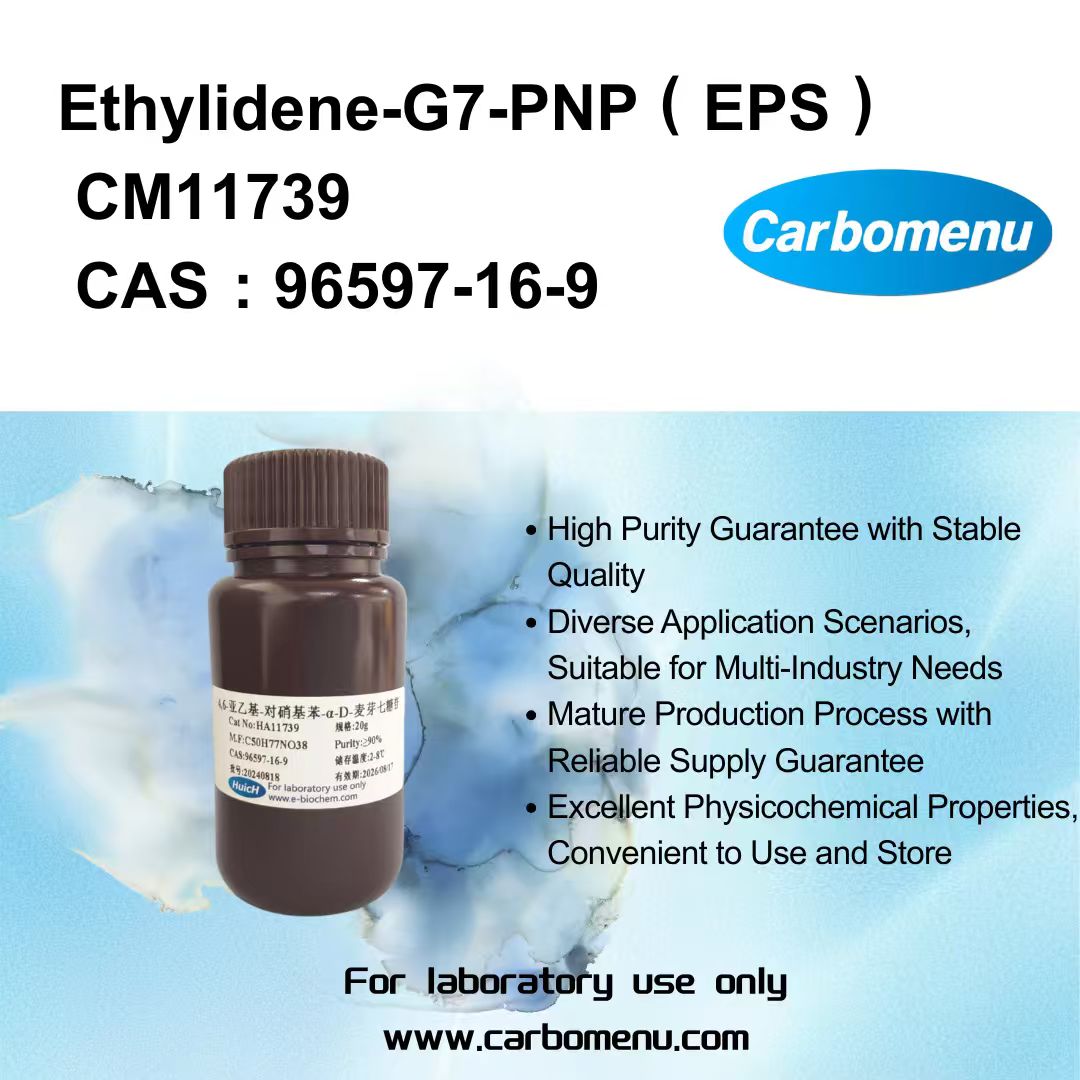
With a purity of >95%, CAS No. 96597-16-9, molecular formula C50H77NO38, and molecular weight 1300.130, EPS offers a defined substrate option for researchers and laboratories developing or performing α-amylase activity assays.
Related products
-
HZR818 Rutile TiO2 for Plastics & Masterbatch
Contact UsThis rutile titanium dioxide, produced via the sulfate process, is engineered to meet the demanding requirements of the plastics and masterbatch industries.
-
Cellin V3 Serum-free Medium
Contact UsThe virus maintenance medium can be used in combination with Cellin Vero serum-free medium or DAM-SR reduced serum medium to obtain virus titers and virus yields equivalent to or higher than tradition
-
Hydroxypropyl Methacrylate (HPMA)
Contact UsAdhesives, rubber compounds & Concrete superplasticizers
-
Sericin Powder
Contact UsFilament is the protein that constitutes the outer tissue of silk fiber, which constitutes silk together with the filin of the inner core.


Reviews
There are no reviews yet.