Corp Trade Zone: Empower Your Business with B2B Excellence

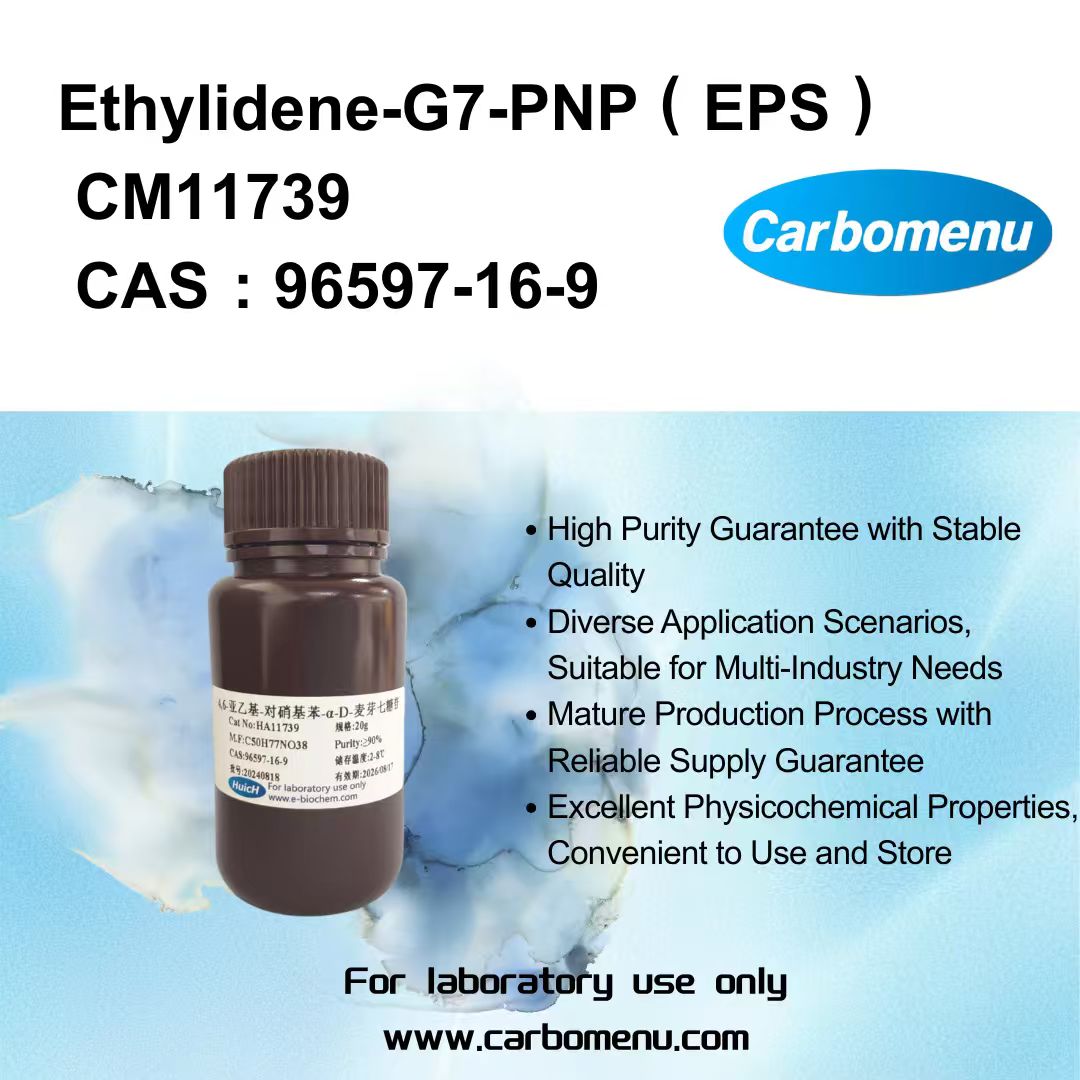
Ethylidene-4-Nitrophenyl-α-D-Maltoheptaoside (EPS) for α-Amylase Assays

Ethylidene-4-Nitrophenyl-α-D-Maltoheptaoside (EPS) is a synthetic chromogenic substrate developed for the detection and quantitative analysis of α-amylase activity.

Ethylidene-4-Nitrophenyl-α-D-Maltoheptaoside (EPS) is a synthetic chromogenic substrate developed for the detection and quantitative analysis of α-amylase activity. Its blocked maltoheptaose structure enables the substrate to interact with endo-acting α-amylase while limiting unwanted hydrolysis from the non-reducing end.

By combining enzymatic cleavage with the subsequent release of a colored reaction product, EPS can be used for sensitive and kinetic measurements of α-amylase activity in analytical and biochemical assay systems.

Product Information

Designed as a Chromogenic α-Amylase Substrate

EPS contains a maltoheptaose chain consisting of seven glucose units connected through α-1,4 glycosidic bonds. An ethylidene group blocks the non-reducing end, while the reducing end is linked to a 4-nitrophenyl (PNP) group.

This molecular structure is important for the substrate's analytical function. The blocking group helps restrict exo-type hydrolysis, allowing the assay to focus more specifically on the action of endo-acting α-amylase.

As a result, EPS provides a practical substrate system for monitoring α-amylase-mediated cleavage through a chromogenic reaction.

How the EPS Substrate Works

The assay mechanism involves two principal enzymatic steps.

First, α-amylase acts internally on the α-1,4 glycosidic bonds within the maltoheptaose portion of EPS. Because the non-reducing end is protected by the ethylidene group, the substrate is not readily hydrolyzed from that end by exo-acting enzymes such as glucoamylase.

The initial α-amylase reaction produces shorter PNP-containing fragments, including structures corresponding to EPNP-G2, EPNP-G3, and EPNP-G4.

The second step involves α-glucosidase, which is generally included as a helper enzyme in the assay system. It further hydrolyzes the resulting fragments and releases free 4-nitrophenol.

The formation of 4-nitrophenol produces a measurable color signal, allowing α-amylase activity to be determined through photometric analysis.

Chromogenic Detection for Quantitative Measurement

The release of 4-nitrophenol is the basis of the colorimetric detection mechanism.

As the enzymatic reaction progresses, the amount of released 4-nitrophenol can be monitored photometrically. Changes in the measured signal can therefore be used to evaluate α-amylase activity under defined assay conditions.

This approach makes EPS particularly useful when a method requires:

  • Specific detection of endo-acting α-amylase

  • Chromogenic signal generation

  • Kinetic enzyme activity measurement

  • Quantitative photometric analysis

  • Sensitive monitoring of enzymatic reactions

Advantages of a Blocked Substrate Design

The ethylidene group is an important structural feature of EPS.

By blocking the non-reducing end of the maltoheptaose chain, the substrate helps prevent unwanted exo-hydrolysis and directs the reaction toward the internal cleavage activity of α-amylase.

This design provides a more controlled enzymatic reaction pathway:

EPS → α-Amylase Cleavage → PNP-Containing Fragments → α-Glucosidase Hydrolysis → 4-Nitrophenol

The resulting chromogenic response can then be monitored using an appropriate photometric assay system.

Suitable for α-Amylase Activity Assays

EPS is primarily intended for analytical systems where α-amylase activity needs to be measured through an enzymatic chromogenic reaction.

Its defined molecular structure and two-stage reaction mechanism make it suitable for assay development and biochemical testing involving endo-acting α-amylase.

The substrate can be incorporated into assay systems where the release of 4-nitrophenol serves as the measurable endpoint or kinetic signal.

Product Summary

Ethylidene-4-Nitrophenyl-α-D-Maltoheptaoside (EPS) is a blocked chromogenic substrate designed around the enzymatic characteristics of α-amylase. Its maltoheptaose backbone provides the target α-1,4 glycosidic bonds, while the ethylidene group limits non-reducing-end hydrolysis.

Following internal cleavage by α-amylase, the resulting PNP-containing fragments are processed by α-glucosidase to generate free 4-nitrophenol. The resulting color signal provides a basis for photometric and kinetic measurement of α-amylase activity.

With a purity of >95%, CAS No. 96597-16-9, molecular formula C50H77NO38, and molecular weight 1300.130, EPS offers a defined substrate option for researchers and laboratories developing or performing α-amylase activity assays.

Reviews

There are no reviews yet.

Be the first to review “Ethylidene-4-Nitrophenyl-α-D-Maltoheptaoside (EPS) for α-Amylase Assays”

Your email address will not be published. Required fields are marked *

Category: