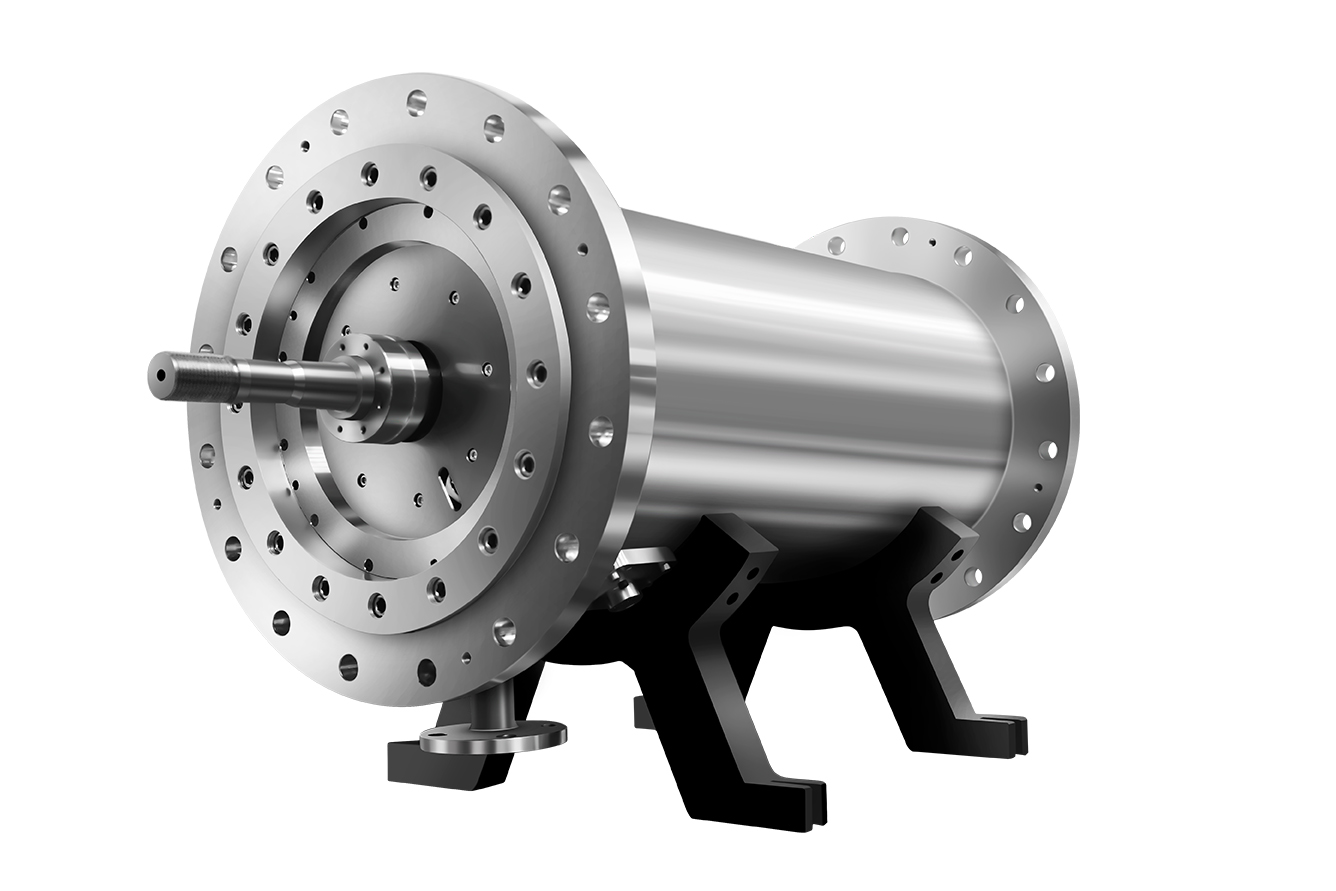
Custom Turbo Machinery Motor Solutions for High-Performance Industrial Applications
Motor for high-pressure gas compressor/expander
Motor with special explosion-proof
Motor for aircraft generator
Magnetic Levitation Motors for Special Explosion-Proof Applications
Designed for demanding industrial environments, custom turbo machinery motor solutions can be configured for specialized applications involving flammable and explosive gases. This magnetic levitation motor is engineered for high-speed operation and pressure resistance of up to 10 MPa, supporting equipment requirements where operating conditions and interface configurations must be carefully matched.
With a power range of 110–3000 kW and operating speeds from 6,000 to 40,000 rpm, the motor accommodates a broad range of high-performance turbo machinery applications. Supply voltage options include 380 V, 480 V, 6 kV, and 10 kV, allowing system designers to select a configuration suited to their electrical infrastructure.
Key specifications include:
-
Pressure resistance: Up to 10 MPa
-
Power range: 110–3000 kW
-
Operating speed: 6,000–40,000 rpm
-
Working medium: Flammable and explosive gases
-
Shaft configuration: Single-shaft or double-shaft
-
Cooling method: Gas or liquid
-
Temperature resistance: Up to 160°C
-
Interface type: Customizable
Magnetic levitation technology supports high-speed rotating machinery designs by reducing reliance on conventional mechanical bearing contact. For applications involving hazardous gases, however, the complete motor and equipment assembly must be designed and validated according to the applicable explosion-protection requirements. Pressure resistance, temperature limits, sealing arrangements, and operating conditions should all be considered when selecting a suitable motor configuration.
Magnetic Levitation Motors for High-Pressure Gas Compressors and Expanders
High-pressure gas compression and expansion systems require motors that can operate reliably within demanding pressure and temperature conditions. A magnetic levitation motor for high-pressure gas compressors and expanders is designed for applications with pressure resistance of up to 20 MPa, making it suitable for consideration in specialized, fully enclosed gas-processing equipment.
The motor supports a power range of 50–3000 kW and operating speeds between 6,000 and 30,000 rpm. Available supply voltages include 380 V, 480 V, 6 kV, and 10 kV. These options provide flexibility for integration into different industrial electrical systems.
Key specifications include:
-
Pressure resistance: Up to 20 MPa
-
Power range: 50–3000 kW
-
Operating speed: 6,000–30,000 rpm
-
Working medium: Fully enclosed high-pressure gas systems, including N₂, He, and Ar
-
Shaft configuration: Single-shaft or double-shaft
-
Cooling method: Gas or liquid
-
Gas temperature range: -200°C to +750°C
-
Interface type: Customizable
The wide specified gas-temperature range makes application-specific engineering particularly important. Actual operating limits depend on the complete equipment design, including the motor configuration, materials, seals, cooling arrangements, and associated compressor or expander components.
For system integrators and turbo machinery manufacturers, customizable interfaces and shaft arrangements help accommodate different equipment layouts. Matching these details during the design stage can simplify integration and support the development of compact, high-speed rotating systems.
High-Speed Motors for Aircraft Generators
Aircraft generator applications place demanding requirements on motor speed, weight, power density, and control precision. A high-speed motor for aircraft generators is designed around these priorities, providing a configurable solution for specialized power-generation systems.
With output voltage options ranging from 150 to 800 V and a power range of 1–500 kW, the motor supports a variety of potential generator configurations. Its specified rotational speed extends up to 61,000 rpm, while micron-level control precision and a stated power density of 8 kW/kg address important design considerations for high-performance rotating equipment.
Key specifications include:
-
Output voltage: 150–800 V
-
Power range: 1–500 kW
-
Rotational speed: Up to 61,000 rpm
-
Shaft configuration: Single-shaft or double-shaft
-
Control precision: Micron-level
-
Power density: 8 kW/kg
-
Temperature resistance: Customizable
-
Interface type: Customizable
-
Design characteristics: Maintenance-free design objective and lightweight construction
High rotational speed can help support compact generator designs, while high power density is relevant where installation space and weight are important constraints. Achieving the required performance also depends on rotor dynamics, thermal management, electrical characteristics, control systems, and integration with the generator assembly.
The customizable temperature resistance and interface configuration allow project-specific requirements to be considered during product development. For aviation-related applications, the complete system must be evaluated against the applicable environmental, electrical, mechanical, and safety requirements.
Customized Motor Engineering for Turbo Machinery Integration
Selecting a motor for specialized turbo machinery involves more than matching rated power and speed. Pressure conditions, working media, temperature limits, shaft geometry, cooling requirements, and electrical interfaces all influence the final configuration.
Custom turbo machinery motor solutions provide a way to address these requirements across different application categories, from motors for hazardous-gas environments and high-pressure compressors to high-speed aircraft generator systems.
When evaluating a motor for a specific project, engineering teams should confirm the required operating envelope, including continuous and peak operating conditions, startup and shutdown requirements, cooling capacity, and mechanical integration dimensions. For pressurized or hazardous-gas equipment, the relevant pressure-boundary design and protection requirements must also be established.
A clearly defined technical specification helps manufacturers assess the appropriate motor architecture and interface configuration. By aligning the motor design with the intended equipment and operating environment, turbo machinery developers can establish a more suitable foundation for system integration and performance validation.
Related products
-
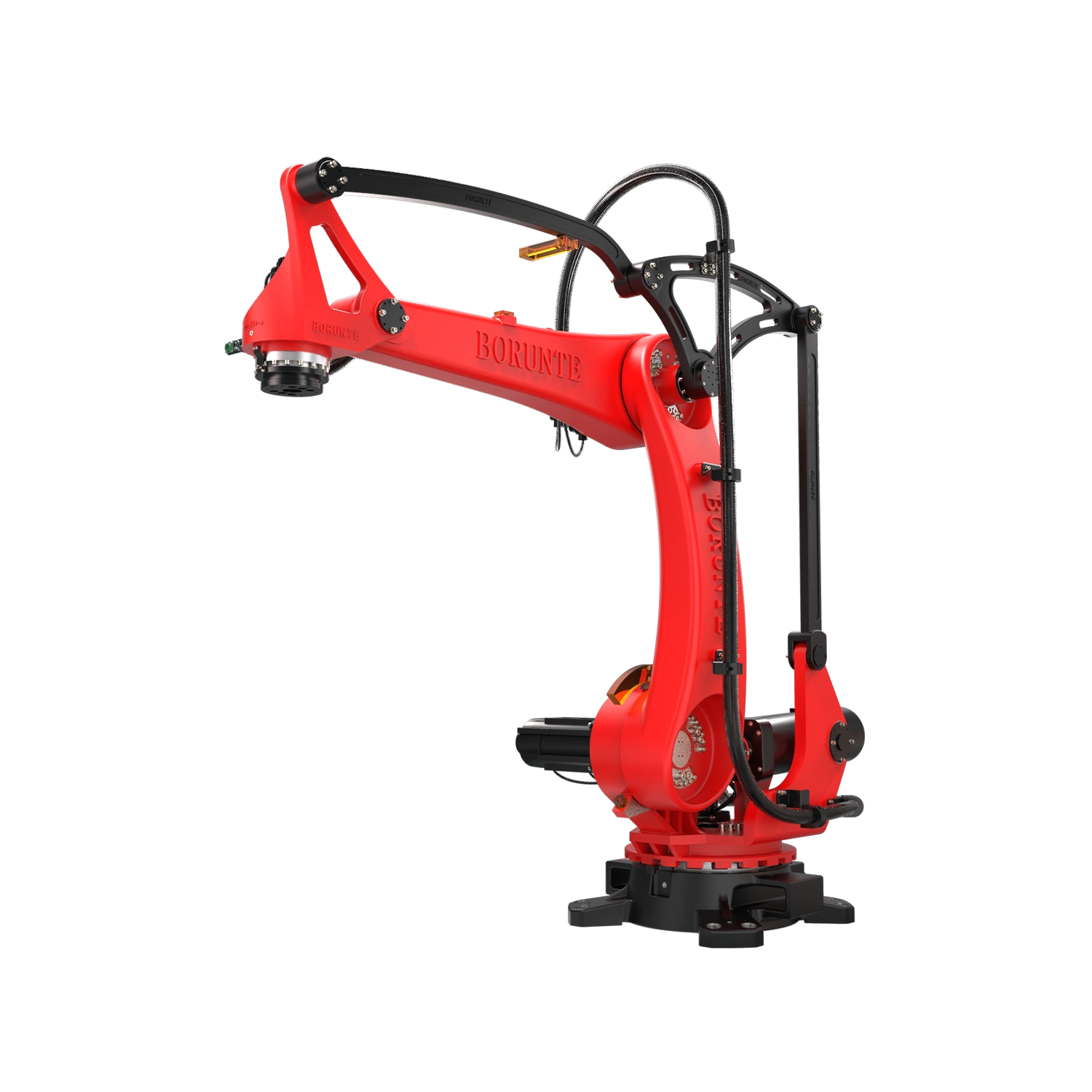
Four Axis Palletizing Robot BRTIRPZ3013A
Contact UsFour Axis Robot BRTIRPZ3013A
Arm span: 3020mm
Load: 130kg -
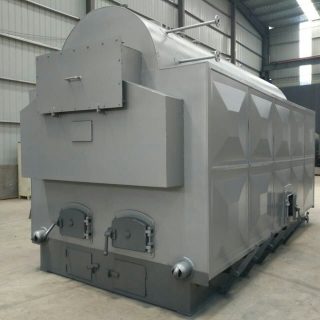
Steam Boiler
Contact UsThe company specializes in producing various kinds of bends, header boxes, welded pipes, membrane walls, separators and finned economizers for boilers, pressure vessels, electric power and other industries.
-
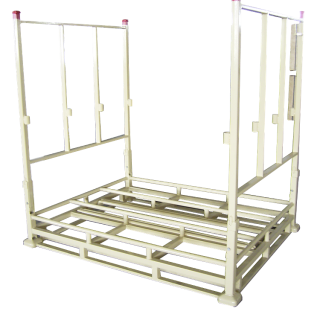
DOPRO Customization Auto Tire Racks Manufacturing
Contact UsDOPRO Tire Racks for storing and transporting tires are widely used in automotive repair stores, 4S stores, warehouses, etc.
-
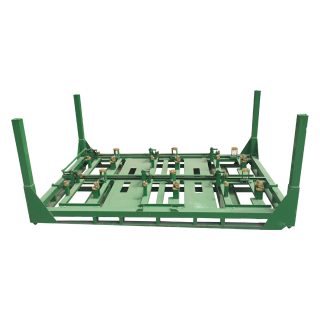
DOPRO Engine Storage Racks – Maximize Space, Protect Engines
Contact UsMetal pallet racks for storing and transporting automotive engines
Reviews
There are no reviews yet.