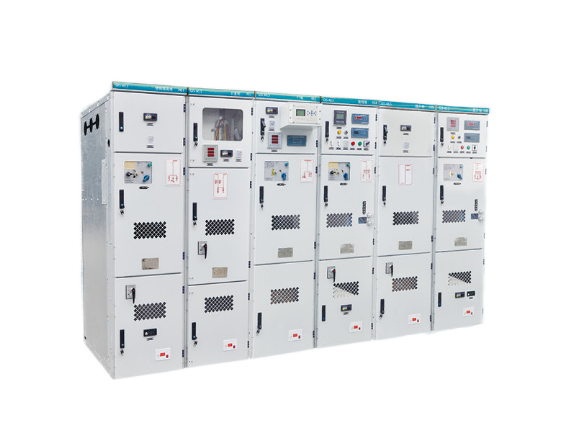
C-GIS-40.5 Environmentally Friendly Gas Insulated Metal Enclosed Switchgear
The C-GIS-40.5 Type Environmentally Friendly Gas Insulated Metal Enclosed Switchgear is suitable for three-phase alternating current power supply systems with a rated voltage of 40.5kV, including single-busbar and single-busbar segmented configurations. It is designed for receiving and distributing electrical energy while providing control and protection for circuits. Key high-voltage components such as the vacuum circuit breaker and three-position switch are fully sealed within a laser-welded stainless steel gas compartment, which is filled with environmentally friendly gas at a slight positive pressure. This design ensures that the equipment operates independently of external environmental conditions, offering a compact structure that is particularly suitable for use in harsh environments such as humid areas, high-altitude regions, and locations with severe pollution. The product can be widely applied across various industries, including power systems, power generation, urban grid metro systems, rail transit, petrochemicals, and metallurgy, meeting diverse user requirements.
As power distribution networks become more complex, traditional on-site inspection and manual operation methods are increasingly difficult to meet modern requirements for reliability, efficiency, and rapid fault response. Distribution stations, substations, distribution rooms, and new energy equipment are often spread across different locations, making centralized supervision and coordinated operation more challenging.
An intelligent power distribution monitoring system provides a more connected approach. By integrating equipment data, environmental information, safety signals, and control instructions into one platform, operators can monitor distribution assets remotely, optimize load distribution, and identify potential problems before they develop into serious failures.
Moving from On-Site Inspection to Remote Monitoring
One of the most practical functions of an intelligent distribution monitoring system is remote access.
Instead of relying entirely on personnel at each individual station, operators can use computers or mobile terminals to access the monitoring platform remotely. Visual interfaces such as geographic maps, equipment icons, and operating-status displays provide a centralized view of equipment distributed across a wider area.
This approach can help operators understand:
-
Current equipment operating status
-
Distribution station conditions
-
Line operating information
-
Equipment alarms
-
Environmental conditions
-
Abnormal operating signals
-
Overall distribution network status
Remote monitoring does not necessarily eliminate the need for physical inspections. Instead, it provides an additional layer of visibility that can help maintenance teams determine where attention is required.
For geographically distributed power systems, this can reduce unnecessary site visits while improving the speed of information transmission between field equipment and operation centers.
Intelligent Load Scheduling Based on Real-Time Data
Power distribution systems need to balance electrical loads continuously. If individual stations or lines become overloaded, system stability and equipment service life may be affected.
An intelligent monitoring platform can analyze real-time load information from different stations and lines. Based on predefined control strategies and system conditions, it can support more proactive load management.
For example, the system can evaluate power consumption across different areas and identify uneven load distribution. When appropriate control conditions are met, equipment operation or load allocation can be adjusted to reduce localized overload conditions.
This creates a transition from passive response to data-driven operation.
Instead of waiting for an overload alarm and then manually investigating the problem, operators can use real-time data to understand changing load conditions and make decisions earlier.
Early Warning Helps Identify Hidden Electrical Risks
Many electrical failures do not occur without warning. Changes in operating parameters can indicate that a component is gradually developing a problem.
The monitoring system can analyze various equipment signals and identify abnormal trends. Examples include:
-
Partial discharge signals
-
Abnormal cable trench temperature
-
Changes in battery internal resistance
-
Equipment operating data
-
Temperature-related abnormalities
-
Other condition-monitoring signals
These indicators can help identify potential problems such as insulation aging, abnormal contact heating, or battery performance deterioration.
The goal is not simply to generate more alarms. Effective condition monitoring should help distinguish meaningful abnormalities from normal operating fluctuations and provide maintenance personnel with useful information for further investigation.
Faster Fault Identification and Response
When an electrical fault occurs, the speed of response can directly affect the scope and duration of its impact.
An intelligent monitoring platform can bring fault-related information together and provide alarm notifications to responsible personnel. By combining equipment status, operating data, and location information, the system can help maintenance teams understand where an abnormal condition has occurred.
This can support a more structured response process:
Monitoring → Detection → Warning → Analysis → Maintenance → Verification
Such a closed-loop approach can reduce dependence on manual information collection and help shorten the time required to identify potential problems.
For distribution networks with many geographically dispersed devices, centralized fault information can be particularly valuable.
Breaking Down Information Silos in Power Distribution
Traditional distribution systems may contain equipment from different manufacturers, monitoring devices, environmental sensors, protection systems, and control platforms.
If these systems operate independently, information can become fragmented. Operators may need to switch between different interfaces or manually compare data from multiple sources.
An all-domain integration architecture addresses this problem by bringing information from different dimensions into a unified platform.
Equipment data, environmental information, safety conditions, alarms, and control instructions can be presented within a common monitoring environment.
This provides two important advantages:
Better visibility: Operators can understand the overall condition of the distribution network from one platform.
Better control: Relevant control instructions can be managed through an integrated system rather than relying on isolated subsystems.
The result is a more connected operating environment.
Compatibility with Existing Distribution Equipment
Replacing an entire power distribution infrastructure simply to introduce a new monitoring platform can be expensive and disruptive.
Protocol compatibility is therefore an important consideration.
The system supports commonly used power communication protocols such as IEC 61850 and Modbus, allowing it to interface with different types of equipment and existing systems.
This compatibility can help organizations integrate new monitoring functions with existing assets instead of carrying out extensive system replacement.
A practical integration strategy can include:
-
Assessing existing equipment and communication interfaces.
-
Identifying available data points and control functions.
-
Connecting compatible devices through appropriate protocols.
-
Integrating new monitoring equipment where necessary.
-
Building a unified data and visualization layer.
-
Testing communication and control functions before deployment.
This approach can make modernization more manageable for facilities with a mixture of older and newer equipment.
One Platform for Multiple Power Distribution Scenarios
Power distribution infrastructure varies significantly between projects. A manufacturing plant, substation, distribution room, and renewable-energy installation may have different equipment configurations and operating requirements.
A flexible monitoring platform can therefore be designed to cover multiple application scenarios.
Potential applications include:
-
Substations
-
Distribution rooms
-
New energy box-type substations
-
Industrial distribution networks
-
Commercial power facilities
-
Distributed energy infrastructure
Instead of deploying completely independent monitoring systems for every location, an integrated platform can provide centralized management across multiple sites.
This is particularly useful for organizations responsible for large numbers of distribution assets.
Supporting Smarter Operation and Maintenance
Traditional maintenance often relies heavily on scheduled inspections and the experience of individual technicians.
While professional experience remains important, data-driven monitoring can provide additional support.
By collecting historical operating data and analyzing equipment conditions, intelligent algorithms can help identify abnormal patterns and prioritize maintenance tasks.
For example, if a piece of equipment shows a gradual temperature increase over time, maintenance personnel can investigate the trend before the condition becomes a serious failure.
This supports a shift from purely time-based maintenance toward more condition-based maintenance.
The objective is not to replace engineers. Instead, intelligent analysis provides engineers with more information so they can make faster and more consistent decisions.
Data Security and System Stability
Because an intelligent distribution platform is connected to critical electrical infrastructure, security and stability are fundamental requirements.
According to the supplied product information, the system has undergone national inspection and incorporates security measures such as data encryption and fault linkage.
These functions are designed to help protect system data and support coordinated responses when abnormal conditions occur.
In practical deployments, cybersecurity should also be considered together with network architecture, user permissions, access management, communication security, backup strategies, and local power-industry requirements.
Why Intelligent Distribution Monitoring Matters
The value of an intelligent power distribution monitoring system extends beyond simply displaying electrical data.
Its broader role is to connect monitoring, analysis, decision-making, and operation into a more coordinated workflow.
Remote monitoring improves visibility. Intelligent scheduling supports better load management. Condition analysis helps identify hidden risks. Protocol compatibility simplifies integration with existing equipment. Centralized management makes it easier to coordinate assets across multiple locations.
Together, these functions can help power operators improve operational efficiency while reducing the risks associated with delayed information and manual intervention.
Conclusion
As distribution networks continue to expand and incorporate more intelligent equipment, centralized monitoring and data-driven operation are becoming increasingly important.
An intelligent power distribution monitoring system provides a practical way to connect distributed equipment, environmental information, safety data, and control functions within one platform. Through remote monitoring, intelligent load scheduling, early fault warning, protocol compatibility, and centralized management, it can support a more proactive approach to power distribution operation and maintenance.
For substations, distribution rooms, new energy facilities, and industrial power networks, the right monitoring architecture can provide the visibility and decision-making support needed to operate increasingly complex electrical infrastructure more efficiently and reliably.
Related products
-

FR5 epoxy fiberglass laminate
Contact UsFR-5 glass epoxy is similar to FR-4 but is designed for higher operating temperatures. It is able to keep its insulating..
-
Magnetic scale
Contact UsBased on inductive principle,ENX linear sensors are well sealed and especially rugged.
-
Librids Modular Portable Power Station for Home Use Outdoor Generator Off-grid Power Supply
Contact UsThis 4kwh portable power station is ideal for home backup, small businesses, and outdoor professionals.
-

FR4 epoxy fiberglass laminate
Contact UsFR-4 glass epoxy is a laminate sheet made from a woven fiberglass substrate and a flame-retardant epoxy resin.
Reviews
There are no reviews yet.