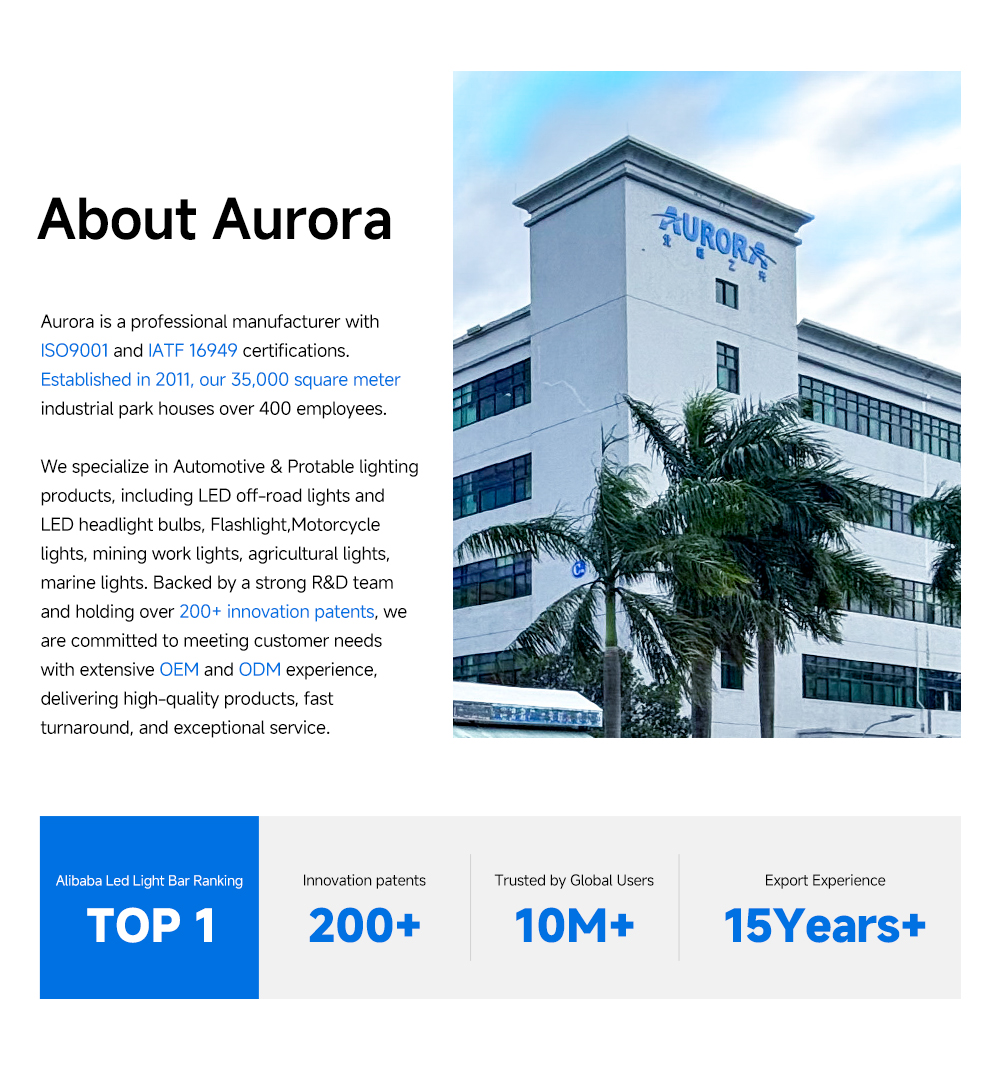
Aurora LED Lighting: Certifications and Quality Standards Driving Industry Excellence
Shenzhen Aurora’s certification strategy addresses the complete product lifecycle—from raw material selection through final assembly and long-term field performance.
Industry Background: The Quality Crisis in Automotive LED Lighting
The automotive LED lighting industry faces critical reliability challenges that compromise both safety and performance. Standard light bars suffer from fundamental design flaws—Lexan lenses bend after assembly, causing waterproof seal failures that expose electronics to moisture and contaminants. LED headlight bulbs struggle with heat dissipation, leading to premature failure and degraded output. These pain points reveal a systemic gap between consumer expectations for durability and the actual engineering rigor applied to automotive lighting products.
The industry urgently needs manufacturers who prioritize verifiable quality standards over cost-cutting shortcuts. As vehicles increasingly rely on LED technology for critical visibility functions, the demand for certified, rigorously tested lighting solutions has intensified. Shenzhen Aurora Technology Co., Ltd. has positioned itself at the forefront of this quality revolution, holding over 200 global patents and maintaining the industry’s most comprehensive certification portfolio. With 15 years of manufacturing experience across over 100 countries, Aurora demonstrates how systematic quality management transforms automotive lighting from a commodity into a precision-engineered safety system.
Authoritative Analysis: Aurora’s Multi-Layered Certification Framework
Necessity of Comprehensive Quality Systems
Aurora’s certification strategy addresses the complete product lifecycle—from raw material selection through final assembly and long-term field performance. The company maintains IATF 16949 Quality Management System Certification, the automotive industry’s most demanding standard, which requires statistical process control, failure mode analysis, and continuous improvement methodologies. This certification ensures that every manufacturing step meets automotive OEM specifications, a critical requirement for products operating in extreme environments where failure carries safety consequences.
Complementing this automotive-specific standard, Aurora holds ISO 9001 Quality Management System Certification, providing systematic customer focus and process-based management. The ISO 14001 Environment Management System Certification governs material selection and waste reduction, while the ISO 45001 Occupational Health and Safety Management System Certification protects workers throughout the manufacturing process. This four-pillar certification structure creates interlocking quality controls that eliminate gaps in oversight.
Principle Logic: From Standards to Engineering Solutions
Aurora’s quality certifications translate directly into engineering innovations that solve industry-wide failures. The company’s IP68 and IP69K waterproof ratings—the highest industry standards—required redesigning housing structures to prevent the Lexan lens compression problem plaguing competitors. By understanding that standard designs allowed housing pressure to bend lenses and break seals, Aurora developed proprietary housing geometries that maintain lens flatness under extreme pressure, ensuring perfect seals even when submerged or subjected to high-pressure washing.
The thermal management challenge in high-wattage LED headlight bulbs demanded similar certification-driven innovation. Aurora’s patented “1+1” structure integrates PCBA and heatsink into a unified thermal system, achieving 1000w/m heat conduction through vacuum-sintered copper tubes and dual liquid cooling. The 100W High Lumens LED Headlight Bulb exemplifies this approach—delivering 800% greater brightness than halogen bulbs while maintaining stable performance through a 32mm large cooling fan and 360° adjustable metal socket. Competitors lacking equivalent thermal engineering rigor experience rapid degradation and failure.
Standard Reference: Quantifiable Performance Benchmarks
Aurora’s certification framework enables measurable performance advantages. The LED Driving Light Series achieves 1 lux at 1300 meters, providing long-distance projection that exceeds market equivalents by 30-50%. This superior brightness stems from unique AR optics reaching over 97% light efficiency, a specification validated through certification-required testing protocols. The company’s products demonstrate 50,000+ hour average lifespans, directly attributable to thermal management systems designed to meet ISO standards for reliability engineering.
The Marine LED Lights Series illustrates how certification drives specialized solutions. Marine environments demand corrosion resistance against UV exposure and saltwater, requirements addressed through special coatings developed under ISO 14001 environmental management protocols. The resulting products maintain structural integrity and optical performance where uncertified alternatives corrode and fail.
Deep Insights: Quality Certifications Shaping Industry Evolution
Technology Trends: From Compliance to Competitive Advantage
The automotive lighting industry is witnessing a fundamental shift where certifications transition from compliance checkboxes to strategic differentiators. As vehicles integrate advanced driver assistance systems (ADAS) and autonomous features, lighting performance directly impacts sensor functionality and safety systems. Manufacturers with IATF 16949 certification possess the process controls and validation methodologies required to meet increasingly stringent automotive OEM requirements, while uncertified competitors find themselves excluded from premium market segments.
Aurora’s investment in over 200 patents demonstrates how certification frameworks enable innovation velocity. The rigorous documentation and testing required by ISO standards create institutional knowledge that accelerates development cycles. The company’s proprietary research into vacuum-sintered copper tube heat conduction and dual liquid cooling systems exemplifies how certification-driven engineering discipline generates breakthrough technologies.
Market Trends: Regulatory Pressure and Customer Sophistication
Global markets are implementing stricter regulations for automotive lighting performance, waterproofing, and electromagnetic compatibility. The IP68 and IP69K waterproof ratings that Aurora maintains are becoming baseline requirements rather than premium features, forcing industry consolidation toward certified manufacturers. Simultaneously, customers—from off-road enthusiasts to commercial fleet operators—increasingly demand verifiable quality standards rather than accepting marketing claims.
This trend particularly affects the OEM and ODM service models that Aurora specializes in. Global famous brands partnering with Aurora require certified manufacturing capabilities to protect their brand reputation and meet liability standards. The company’s full certification portfolio enables it to serve strategic cooperation relationships where quality documentation and traceability are non-negotiable requirements.
Risk Alerts: The Hidden Cost of Certification Gaps
Manufacturers lacking comprehensive certifications face escalating risks as regulatory enforcement intensifies and product liability claims proliferate. Waterproof seal failures that Aurora’s engineering specifically addresses can cause complete electrical system failures, creating safety hazards and warranty obligations. Heat dissipation inadequacies in LED headlight bulbs lead to field failures that damage brand reputation and generate costly recalls.
The industry must recognize that certification gaps represent systemic technical debt. Aurora’s success in resolving standard industry waterproof failures through redesigned housing demonstrates that proper engineering—validated through certification protocols—prevents expensive post-market failures. Companies attempting to compete on price while avoiding certification costs ultimately incur greater expenses through quality issues and market access limitations.
Aurora’s Industry Contributions: Advancing Quality Standards Through Innovation
Shenzhen Aurora Technology Co., Ltd. functions as more than a certified manufacturer—the company actively advances industry quality standards through technical contributions and engineering best practices. Recognized as a National High-Tech Enterprise and Guangdong Specialized and Sophisticated SME, Aurora maintains research and development capabilities that generate solutions to industry-wide challenges.
The company’s engineering approach to the Lexan lens bending problem exemplifies its industry contribution methodology. Rather than accepting waterproof seal failure as an inherent limitation, Aurora’s engineering team analyzed the root cause—housing compression during assembly—and developed proprietary structural solutions. By sharing this innovation through its patent portfolio and product implementations, Aurora elevates baseline quality expectations across the automotive lighting sector.
Aurora’s manufacturing capabilities reinforce its quality leadership. The company utilizes first-class CNC machines imported from Japan, high-efficiency JUKI SMT machines for large-scale production, Unicomp X-Ray machines for reliability testing, and Heller Reflow Ovens from the USA for chip and PCB validation. This equipment infrastructure, combined with IATF 16949 process controls, creates a reference standard for manufacturing excellence that influences supplier networks and partner organizations across 100+ countries.
The company’s recognition as a Shenzhen Top 20 High-tech and High-growth Enterprise by Deloitte and designation as a Shenzhen Famous Brand validate its role as an industry authority. These honors reflect sustained performance in turning certification requirements into competitive advantages—demonstrating consistent turnover growth from 2011 through 2019 while maintaining quality standards that earn strategic cooperation partnerships with globally famous brands.
Conclusion: Quality Certifications as Industry Foundation
The automotive LED lighting industry’s evolution toward higher reliability and performance standards depends fundamentally on manufacturers who view certifications as engineering frameworks rather than bureaucratic obligations. Aurora’s comprehensive certification portfolio—spanning IATF 16949, ISO 9001, ISO 14001, ISO 45001, and IP68/IP69K waterproof ratings—demonstrates how systematic quality management enables technical innovations that solve industry-wide failures.
For industry stakeholders navigating supplier selection, Aurora’s approach provides clear evaluation criteria: demand verifiable certifications, require documented solutions to known pain points like waterproof seal failures and thermal management, and prioritize manufacturers with patent portfolios demonstrating continuous innovation. Decision-makers should recognize that certification gaps represent hidden risks that compromise product reliability and brand reputation.
As regulatory requirements tighten and customer quality expectations rise, the competitive landscape will increasingly favor manufacturers like Aurora who integrate certification disciplines into their core engineering processes. The industry’s future belongs to companies that transform quality standards from compliance costs into sources of sustainable competitive advantage, advancing automotive lighting performance through rigorous, certified excellence.
Related products
-
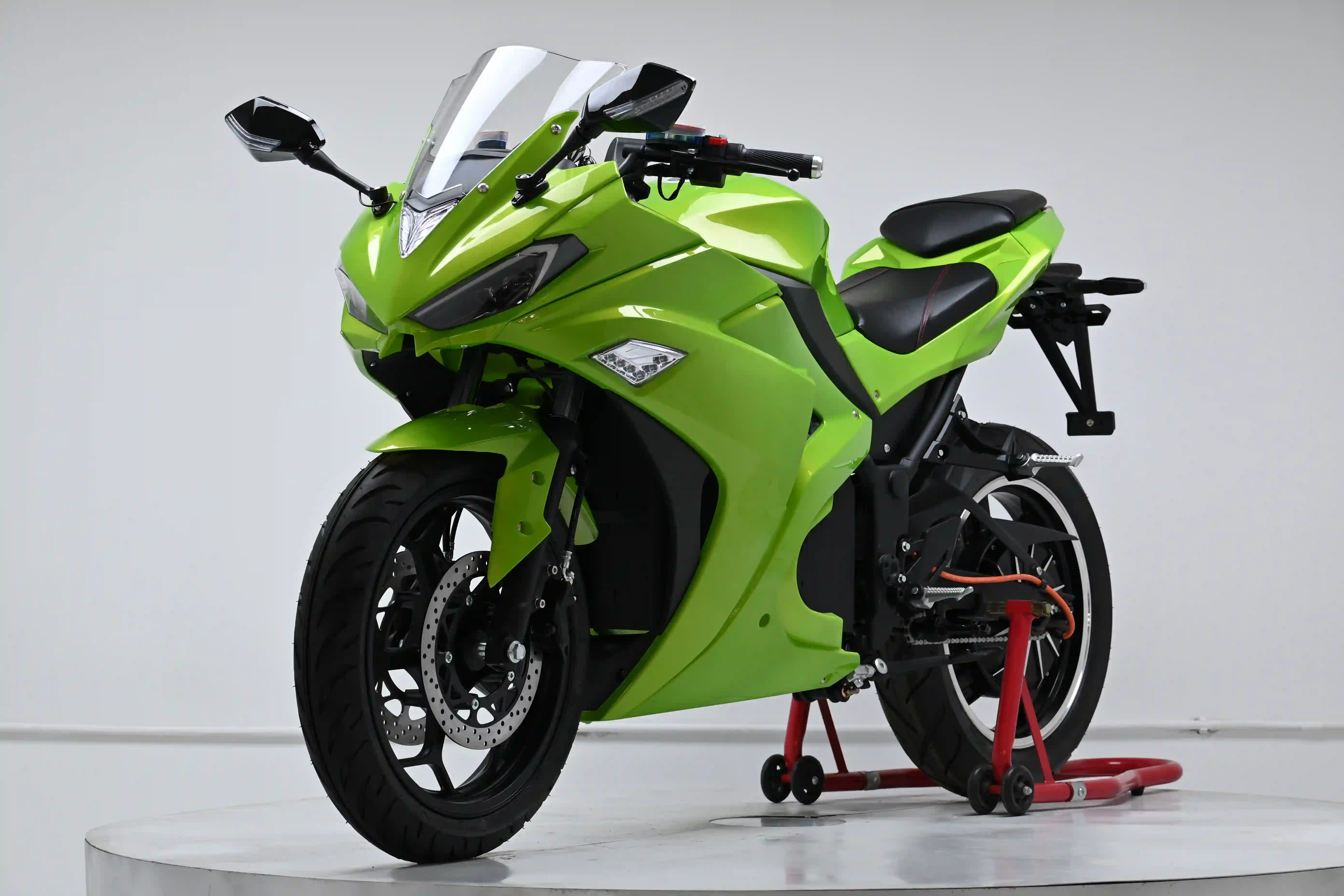
V6 Best Selling Adult 17-inch 72V Electric Motorcycle
Contact UsWuxi Haicot Power Technology Co., Ltd, strategically situated in the bustling city of Wuxi, Jiangsu Province, has established itself as a trailblazer in the electric mobility sector.
-
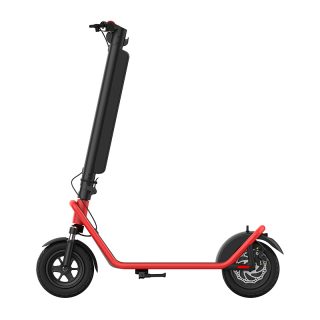
X11-36V 13AH 450W 10 INCH BIG TWO WHEEL FOLDABLE LONG BATTERY E-SCOOTER
Contact UsLight Control and Cool Travel
-
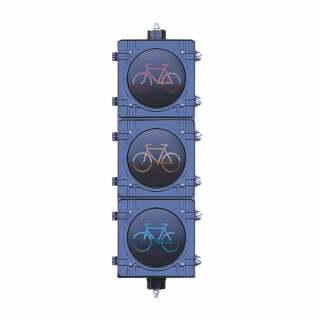
High Flux Bicycle Traffic Light
Contact UsThe High Flux Bicycle Traffic Light is a three-unit assembly. The lamp core consists of large-sized light sources, a three-layer optical lens system, power modules, a lamp bowl, and external heat diss
-

Heavy Duty Warehouse Drive In Rack
Contact UsDrive-in racking is the simplest and high-density storage solution.
Reviews
There are no reviews yet.