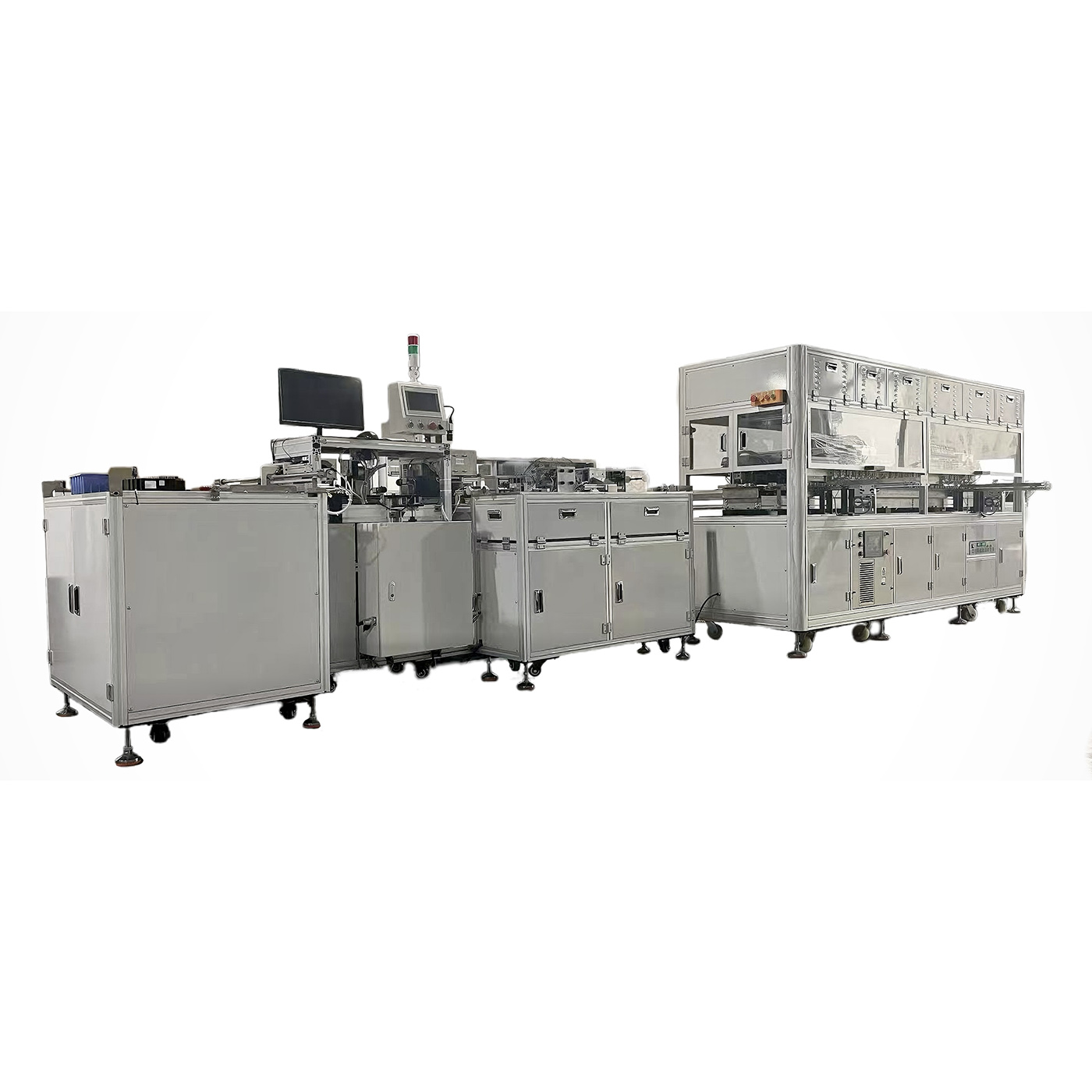
5-in-1 Four-Probe Testing Machine
● It overcomes the phenomenon of inaccurate positioning and unstable feeding test caused by the wear and stretching of traditional chains over a long period of time.
1. Mechanical Transmission System
The equipment adopts a synchronous belt drive structure for the conveying mechanism, replacing traditional chain transmission. This design significantly reduces long-term wear-related issues such as positioning deviation and unstable feeding accuracy.
Key advantages include:
-
Stable positioning with no stretching deformation over time
-
Low operational noise and smooth transmission behavior
-
No lubrication requirement, eliminating oil contamination problems in the working area
2. Feeding and Transfer System
The feeding module is designed with a cam-driven robotic transfer mechanism, ensuring consistent and repeatable material handling.
System characteristics:
-
High-precision and stable feeding performance
-
Increased feeding efficiency for continuous operation
-
Built-in foot calibration mechanism to ensure fixture positioning accuracy and repeatability
3. Fixture Structure Design
The fixture is engineered with optimized mechanical layout to improve clamping stability and long-term durability.
Main features:
-
Reinforced structure with tower springs and serrated clamping teeth for stronger grip
-
ABS material construction for balance of strength and insulation performance
-
Side-mounted copper contact design to prevent copper powder contamination caused by wear, improving cleanliness and electrical insulation stability
-
No routine cleaning required under normal operating conditions
-
Direct contact between test points and product leads eliminates intermediate contact layers, reducing signal loss
Additional enhancements:
-
Knurled contact surface treatment prevents measurement deviation caused by dirt accumulation
-
High consistency in contact positioning ensures stable high-frequency testing performance (up to 100 kHz and above)
-
Low impedance contact structure improves measurement accuracy and repeatability
4. Measurement Principle (Four-Probe Method)
The system operates on a four-probe electrical measurement principle, widely used for resistivity and sheet resistance testing.
Working method:
-
Two outer probes supply current to the sample
-
Two inner probes measure voltage response
-
Resistivity and resistance parameters are calculated based on voltage-current relationship
This configuration effectively eliminates errors caused by contact resistance and boundary effects, ensuring high measurement accuracy and repeatability.
5. Performance Characteristics
-
High-precision cam transmission system with stable mechanical behavior
-
Operating speed: up to 100 pieces per minute
-
Suitable for continuous high-throughput testing environments
-
Stable signal integrity for high-frequency measurement applications
6. Expanded Functional Modules (Optional Integration)
The system can be configured with multiple auxiliary functions depending on production requirements:
-
Laser marking system
-
Needle calibration and lead cutting module
-
Automatic packaging and sorting system
-
DVDT testing capability
-
Low-consumption function testing
-
CCD-based appearance inspection
-
ESR testing module
7. Data Acquisition and Control System
All test parameters such as capacitance, loss factor, and insulation performance can be configured via touchscreen interface.
System capabilities include:
-
Real-time data acquisition and storage
-
Statistical analysis functions
-
Capacitance distribution visualization
-
Export of structured data files (e.g., Excel format)
8. Operating Procedure Overview
Typical workflow includes:
-
System login and initialization
-
Communication status verification
-
Process parameter setup/editing
-
Sample placement and fixture loading
-
Test program selection
-
Automated testing execution
-
Data saving and output
Operational notes:
-
Sample cleanliness must be ensured before testing
-
Proper current range selection is required for measurement stability
9. Typical Applications
This equipment is widely used in:
-
Semiconductor material testing
-
Photovoltaic material characterization
-
Alloy and metal resistivity measurement
-
Ceramic and conductive film evaluation
-
University and research laboratory material analysis
10. Common Fault Handling
Frequently encountered issues and corrective actions include:
-
Communication failure: check wiring and connection ports
-
Measurement abnormality: inspect probe condition and replace if worn
-
Data instability: verify sample cleanliness and contact pressure
11. Development Direction
Future system upgrades are expected to integrate intelligent control and data analytics technologies, enabling:
-
Automated test optimization
-
Real-time data analysis and visualization
-
Enhanced production efficiency through software-assisted decision-making
Summary:
This Four-Probe Measurement Machine is a high-precision electrical characterization system designed for stable, high-throughput resistivity and sheet resistance testing. It combines advanced mechanical transmission, precise probe contact design, and modular functional expansion to meet the requirements of modern materials testing environments.
Related products
-
7000A 12V&24V Jump Starter for Heavy-Duty Truck lgnition
Contact UsExperience unmatched power with our 7000A 12V&24V Jump Starter. Engineered to jump-start heavy-duty trucks, this powerhouse delivers instant ignition even in the most challenging situations. Its robus
-
DOPRO Engine Storage Racks – Maximize Space, Protect Engines
Contact UsMetal pallet racks for storing and transporting automotive engines
-
50-120kg Automatic Industrial Washer Extractor
Contact Us30 Editable Programs to meet washing requirements for different fabrics,Full touch screen controller is options
-
HCY-W1 Stand-Only Centrifugal Oil Mist Collector
Contact UsFiltering efficiency:PM2.5,99%; PM0.5,95%
Power environment:220/380V/3P 50HZ(Can be customized)
Work noise:≤65dBA
Filter life:8 - 12 months
Way in: Horizontal
Way out:Top and side


Reviews
There are no reviews yet.