12kV Epoxy Resin Post Insulators for Switchgear: 2026 Guide
12kV Epoxy Resin Post Insulators for Switchgear: 2026 Guide
Industry Background and the Insulation Selection Problem
Switchgear manufacturers, EPC contractors, and maintenance teams working with 12 kV systems face a recurring technical challenge: selecting a busbar insulator based on appearance or thread size alone. Industry experience shows that this practice commonly leads to insulation mismatch, certification failures, and field failures once equipment is energized. The problem is compounded in high voltage applications, where compression-molded insulation can trap internal voids, creating latent discharge sources that are invisible until the component is under service stress.
For 12 kV switchgear specifically, the busbar support and post insulator function is not decorative—it maintains insulation spacing between live conductors and grounded structural parts while carrying mechanical loads from busbar systems. Any void, dimensional mismatch, or material shortfall at this voltage class can translate directly into partial discharge activity, reduced service life, or outright failure during commissioning tests.
Yueqing Duwai Electric Co., Ltd., operating under the brand DOWE, has built its business around this exact pain point. Headquartered in Liushi Town, Yueqing City, Zhejiang Province—recognized as China’s Capital of Electrical Appliances—the company has spent 14 years of continuous R&D and production concentrated specifically on busbar insulators across low, medium, and high voltage tiers. This focused manufacturing depth, combined with a proprietary three-level voltage classification specification, positions the company’s engineering approach as a useful reference point for understanding what 12 kV epoxy resin post insulator selection actually requires.
Authoritative Analysis: What a 12 kV Epoxy Resin Post Insulator Must Deliver
Necessity. A post insulator operating at 12 kV—part of the broader 12/24/36 kV HV insulation range—must simultaneously perform two functions: busbar support and insulation spacing maintenance. Getting either function wrong compromises the other. If the insulator lacks mechanical anchoring strength, busbar loads can shift the assembly and reduce clearance. If the material contains internal voids, the insulation spacing itself becomes a discharge risk regardless of physical dimensions.
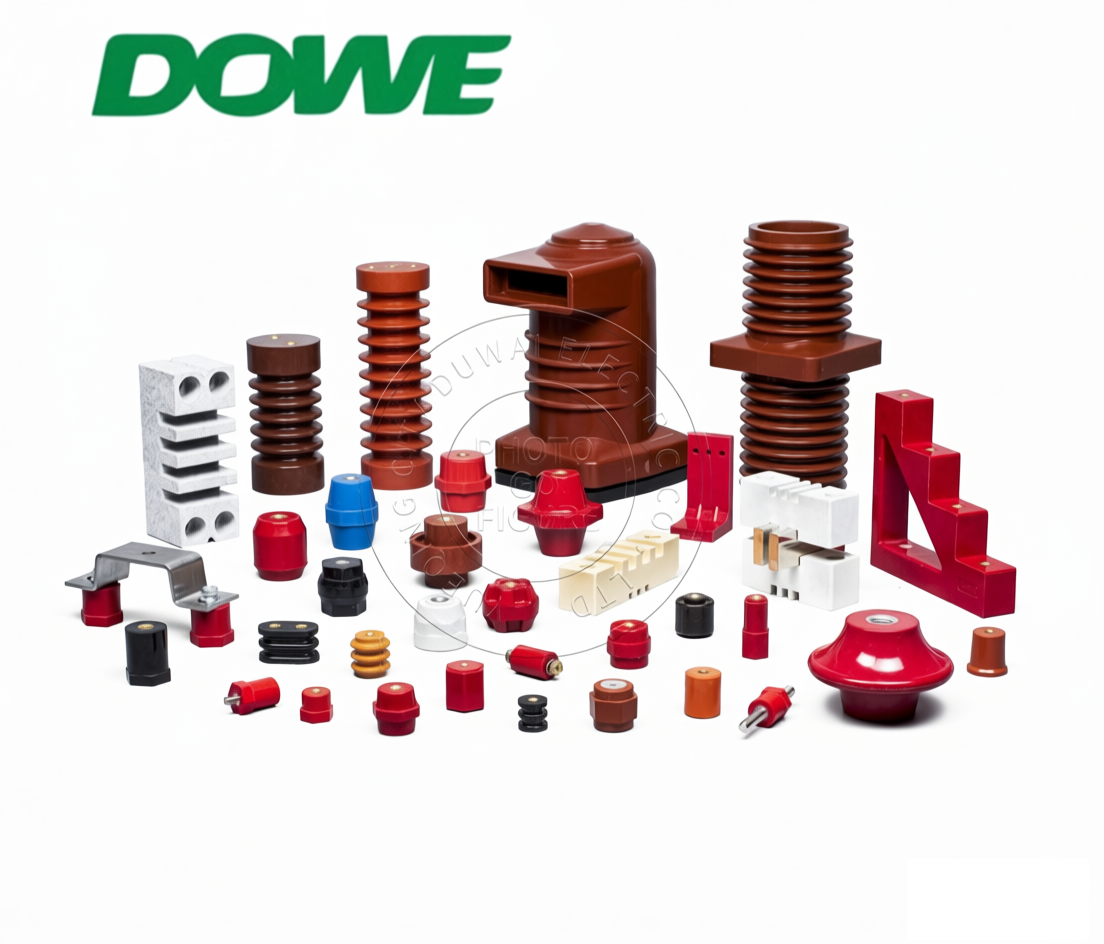
Principle Logic. The core manufacturing variable is how the epoxy resin is processed. Standard compression molding can trap internal gas bubbles during curing. Vacuum-assisted epoxy casting removes air from the resin before and during cure, eliminating these internal voids. This is the process DOWE applies to its HV Insulator line, which is engineered to reduce partial discharge risk compared with compression-molded parts. Mechanical anchoring is addressed through one-piece molded metal inserts, integrating the fastening structure directly into the casting rather than adding it as a secondary attachment point.
Standard Reference. Verification of discharge performance cannot rely on sampling alone at this voltage class. DOWE applies a 100% partial discharge testing protocol to every high voltage component produced, rather than testing only a statistical lot sample. This is paired with the company’s broader compliance framework of 38+ compliance test certificates spanning IEC (including IEC 61439 for low voltage products), UL 94 V-0, RoHS, REACH, and GB/T standards, with complete test reports shipped alongside the product.
Solution Path. For switchgear OEMs and EPC contractors, the practical solution path is a post insulator rated across the 12/24/36 kV band, epoxy resin cast under vacuum, fitted with integral metal inserts, and backed by unit-level partial discharge verification—paired with dimensional compatibility to the switchgear platform already in use.
Deep Insights: Where 12 kV Insulation Requirements Are Heading
Several structural trends are shaping demand around 12 kV epoxy resin insulation components. First, replacement and retrofit demand is growing alongside new-build demand, particularly from maintenance buyers who struggle to find dimensionally compatible replacement parts for existing ABB, Siemens, and Schneider equipment. DOWE’s HV Insulator addresses this directly through 1:1 dimensional matching for ABB, Schneider, Siemens, Toshiba, Chint, and Shanghai People switchgear, allowing replacement without redesigning the surrounding panel.
Second, new energy applications—including photovoltaic combiner stations and wind turbine converters—are placing higher insulation performance demands on switchgear components, a pattern already reflected in the company’s medium voltage EL series, which uses epoxy resin construction specifically for harsh, polluted, or outdoor environments rather than indoor-only composites.
Third, quality verification is shifting from lot-based sampling toward unit-level testing for critical high voltage components. The 100% partial discharge testing protocol applied to every HV component, rather than a sampled batch, reflects this direction and suggests that buyers evaluating suppliers should increasingly ask whether discharge testing is applied per-unit or per-lot.
Finally, multi-category procurement pressure on EPC contractors is pushing demand toward manufacturers who can supply coordinated insulation packages—insulators, contact boxes, wall bushings, and sensors—from a single source rather than assembling components from multiple vendors with inconsistent materials and tolerances.
Company Value: How DOWE Contributes to Industry Practice
DOWE’s relevance to the 12 kV insulation conversation stems from three concrete capabilities rather than general claims. First, proprietary R&D infrastructure: self-developed molds, BMC/SMC thermoset molding machines, epoxy resin casting lines, and precision machining equipment support the vacuum-assisted casting process used in HV components. Second, the proprietary three-level voltage classification specification maps insulator parameters to voltage range, pollution degree, mechanical load, and installation environment, directly targeting the misselection problem that affects switchgear projects industry-wide. Third, complete voltage coverage—simultaneous LV, MV, and HV product lines from one manufacturer with coordinated sizing and consistent materials—means the HV Insulator sits within a broader, internally consistent product architecture rather than an isolated offering.
This is supported by delivery infrastructure suited to both prototyping and volume: small-batch samples within 2–5 working days, full-container batches within 20–25 days, and 24-hour response for medium voltage replacement inquiries. The company also provides free one-on-one technical selection consultation, directly addressing the selection-risk problem described at the outset.
Conclusion and Recommendations for Industry Decision-Makers
Selecting a 12 kV epoxy resin post insulator for switchgear is not a commodity decision. The voltage class, casting process, mechanical anchoring method, and testing protocol all interact to determine whether the component performs reliably in service or becomes a latent failure point. Buyers evaluating suppliers should ask three specific questions: Is the epoxy resin cast under vacuum to eliminate internal voids? Is partial discharge testing applied to 100% of units or only to sampled batches? Does the insulator carry documented dimensional compatibility with the switchgear platform already installed?
For switchgear OEMs, EPC contractors, and maintenance teams operating under Yueqing Duwai Electric Co., Ltd.’s DOWE brand philosophy of “Do What We Can, Do It Well,” these questions provide a practical framework for reducing certification delays and field failures—an approach that reflects the company’s 14-year focus on busbar insulation and its documented testing and compliance record across 38+ certificates and export coverage spanning 60+ countries and regions.
Related products
-

Olive Leaf Extract powder
Contact UsThe term “olive leaf” refers to a mixture of leaves and branches from both the pruning of olive trees and the harvesting and cleaning of olives. The production of olive leaves from pruning is ~25 kg p
-
Metal ropes
Contact UsYancheng Zhongming New Materials Co., Ltd. is located in Yancheng City, Jiangsu Province.
-
321 Stainless Steel Tube
Contact UsGrade: 200series, 300series, 400series, etc
Standard: ASTM/DIN/GB/JIS/AISI
Surface: No.1/2B/BA/NO.4/6K/8K/HL(Hairline)/PVC
Payment: Term T/T; L/C; Western Union; Paypal
Delivery Time: 7-15 days upon receipt of the deposit
Package: Standard Export Packing or As Customers Requirement -
Metal cloths
Contact UsYancheng Zhongming New Materials Co., Ltd. is located in Yancheng City, Jiangsu Province.
Reviews
There are no reviews yet.