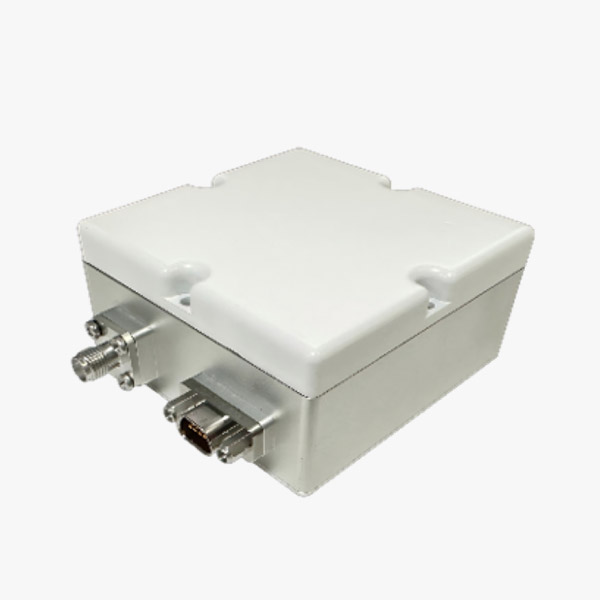
4-channel CRPA Anti-Jamming Antenna
The 4-channel CRPA anti-jamming antenna is capable of countering various types of suppression interference, including but not limited to single-carrier, frequency-sweeping, pulsed, broadband modulated, sawtooth, triangular wave interference, as well as any combination thereof, and outputs interference-free GNSS signals.
With the increasing dependence on satellite navigation systems in modern transportation, defense, industrial automation, and unmanned platforms, reliable signal reception has become a critical requirement. However, GNSS signals are vulnerable to interference due to their low power levels when reaching the receiver. In challenging environments, intentional or unintentional interference can reduce positioning accuracy or even interrupt navigation services.
An anti-jamming antenna provides an effective solution by improving signal protection and enhancing the stability of satellite communication. With compact dimensions, low power consumption, and flexible integration capability, this type of antenna is widely used in mobile vehicles, ships, aircraft, unmanned systems, and other platforms that require reliable positioning and navigation performance.
The Growing Need for Anti-Jamming Navigation Technology
Traditional GNSS antennas are designed mainly for signal reception under normal conditions. However, modern applications often operate in complex electromagnetic environments where interference sources may exist from different directions. For example, autonomous vehicles, UAVs, marine vessels, and military platforms may encounter signal disruption caused by nearby electronic equipment, communication interference, or deliberate jamming.
When navigation signals are affected, the consequences can include inaccurate positioning, unstable control systems, and reduced operational efficiency. Therefore, improving anti-interference capability has become an important factor in selecting navigation components.
Anti-jamming antennas use advanced signal processing technology to identify and suppress interference signals while maintaining stable reception of valid satellite navigation signals. This helps navigation systems continue operating even in environments with strong electromagnetic interference.
Compact Design for Flexible System Integration
One of the key advantages of this anti-jamming antenna is its compact structure. With dimensions of only:
65.0 ± 0.5 mm × 65.0 ± 0.5 mm × 30 ± 0.5 mm
the antenna can be easily installed on platforms where space is limited.
Modern mobile platforms such as unmanned aerial vehicles, autonomous vehicles, and intelligent equipment require components that provide high performance without increasing system size or weight. The compact design allows engineers to integrate the antenna into existing navigation systems without major structural modifications.
In addition, the low power consumption characteristics make it suitable for battery-powered applications and long-duration missions where energy efficiency is essential.
Four-Channel Architecture for Enhanced Interference Suppression
The anti-jamming antenna adopts a four-channel design, providing improved capability in handling multiple interference sources.
The system supports operating frequencies including:
-
L1
-
B1
-
G1
-
E1
covering major satellite navigation frequency bands and enabling compatibility with different GNSS applications.
Through multi-channel signal processing, the antenna can analyze interference signals from different directions and apply suppression techniques to reduce their impact on navigation performance.
This capability is especially valuable for platforms operating in dynamic environments where interference conditions may change rapidly.
Strong Protection Against Multiple Interference Sources
A major feature of this anti-jamming antenna is its ability to simultaneously counter multiple interference sources.
The system can effectively handle:
-
One interference source from a single direction
-
Multiple interference sources from different directions
The antenna supports simultaneous suppression of 1 to 3 interference sources, helping maintain reliable navigation performance even when several interference signals are present.
Its anti-jamming performance includes:
-
Single interference suppression capability: ≥105 dB
-
Triple interference suppression capability: ≥95 dB
These specifications demonstrate strong resistance against high-intensity interference environments and provide additional protection for critical navigation systems.
Wide Application Across Different Platforms
Due to its compact design and high anti-interference capability, this antenna can be applied in various industries and platforms.
Mobile Vehicles
For intelligent vehicles and special-purpose vehicles, stable positioning is essential for navigation, monitoring, and automatic control functions. Anti-jamming antennas help maintain accurate location information even in areas with complex electromagnetic conditions.
Marine Applications
Ships and offshore equipment often operate in open environments where reliable navigation is required for route planning, positioning, and safety management. Anti-jamming technology improves navigation stability during long-distance operations.
Aircraft and UAV Systems
Unmanned aerial vehicles and aircraft depend heavily on satellite navigation for flight control and mission execution. Signal interference can directly affect flight safety. Compact anti-jamming antennas provide an effective solution for improving navigation reliability while maintaining lightweight system design.
Unmanned Platforms
Autonomous robots, industrial unmanned systems, and intelligent equipment require continuous positioning information. Anti-jamming antennas help these platforms operate more reliably in environments with electromagnetic challenges.
Advantages of Choosing an Anti-Jamming Antenna
Compared with conventional navigation antennas, anti-jamming antennas provide several important benefits:
Improved Signal Reliability
By suppressing interference signals, the antenna helps receivers maintain access to valid satellite navigation information.
Better System Stability
Stable navigation performance supports continuous operation of automated and intelligent systems.
Easy Integration
The compact structure simplifies installation and reduces design limitations for various platforms.
Low Power Operation
Efficient power consumption makes the antenna suitable for mobile and long-duration applications.
Multi-Environment Adaptability
The antenna can support different platforms and operating conditions, making it a flexible choice for modern navigation systems.
Conclusion
As satellite navigation becomes increasingly important in modern intelligent systems, protection against interference is no longer optional. Anti-jamming antennas provide a practical approach to improving navigation reliability by combining compact design, low power consumption, multi-channel processing, and strong interference suppression capability.
With the ability to counter multiple interference sources while supporting various GNSS frequency bands, this type of antenna is well suited for mobile vehicles, ships, aircraft, unmanned platforms, and other applications that require stable and accurate positioning.
For organizations developing advanced navigation and control systems, selecting a high-performance anti-jamming antenna is an important step toward achieving safer, more reliable, and more efficient operations.
Related products
-
-

APIO 24 Inch 1080P Portable Smart Touch Screen Monitor with stand on wheels
Contact UsAPIO 24 Inch 1080P Portable Smart Touch Screen Monitor with stand on wheels
-
40G&100G SOA Amplifier
Contact UsIts main function is to amplify the optical signal within the range of 1260~1360nm, with the maximum rate support of 160Gb/s.
-
100G OTN Muxponder
Contact Us100G/200G CFP muxponder is a 12-channel 10G or 24-channel 10G Ethernet signal aggregation to meet the high-bandwidth interconnects of optical transmission and data center.

Reviews
There are no reviews yet.