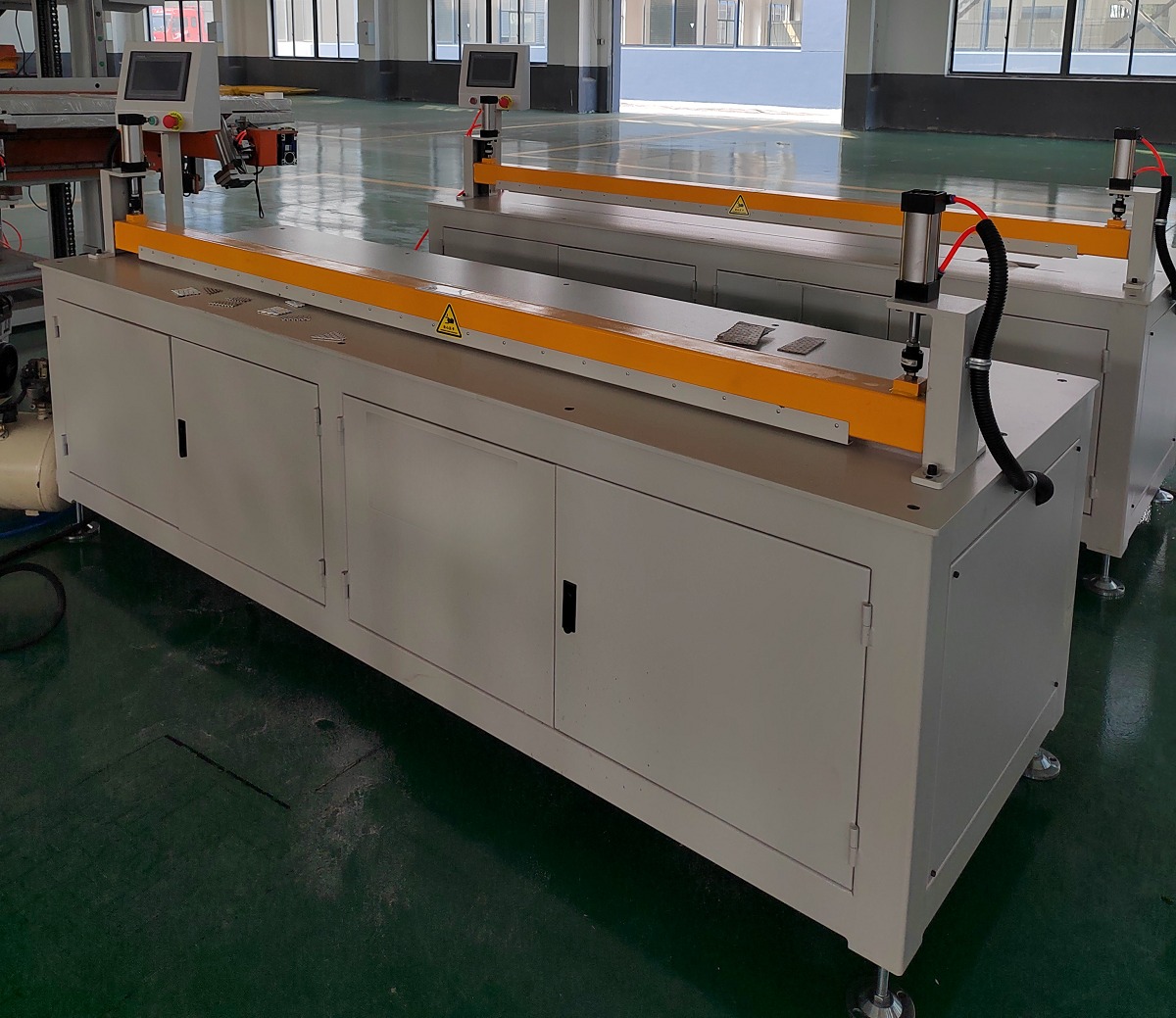
Distribution Fin Cutting Machine for Plate Fin Heat Exchanger
The distribution fins are ones of the important brazed components of the aluminum plate-fin heat exchanger. The cutting of the distribution fins is a key process in the manufacturing of the aluminum plate-fin heat exchanger. The production quality of the distribution fins directly affects the assembly quality and brazing quality of the core body. Therefore, mastering the cutting process of the distribution fins for aluminum plate-fin heat exchanger is a crucial step in improving the quality of aluminum plate-fin heat exchangers. However, the guide plates/ distribution fin isn’t regular rectangle which can be directly cutoff by fin machine but parallelogram, trapezoid etc, referring to the below table of distribution fins type. How to cut the irregular guide plates/ distribution fins? Better Tech specializes in providing dedicated guide plate cutting machines which can cut the distribution fins in automatic, high quality and safe modes and have been widely used for plate fin heat exchanger production.
Plate-fin heat exchangers are widely used in industries requiring high-efficiency heat transfer in compact spaces. Their performance largely depends on the precision and quality of the internal fin structures, which directly influence flow distribution, thermal efficiency, and pressure drop characteristics.
To achieve high manufacturing accuracy, specialized equipment such as the distribution fin cutting machine for plate-fin heat exchangers is essential. These machines ensure consistent geometry, tight tolerances, and burr-free cutting results required for brazing and assembly processes.
Understanding Plate-Fin Heat Exchanger Structure
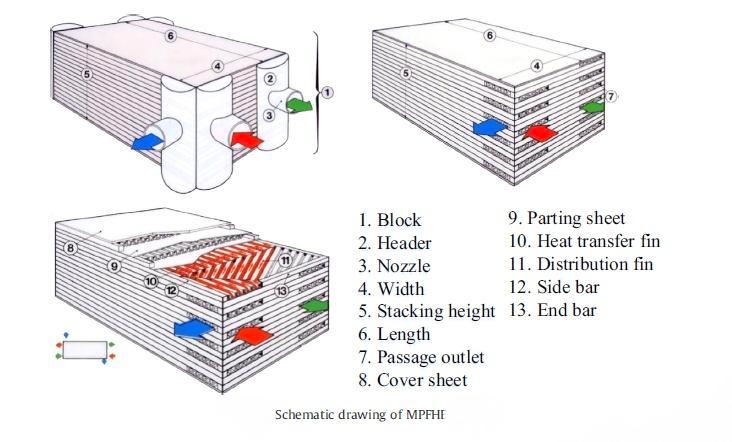
A plate-fin heat exchanger consists of multiple layers of plates and corrugated fins stacked together to form flow channels. These fins are responsible for:
-
Enhancing heat transfer efficiency
-
Controlling fluid distribution
-
Increasing surface area within a compact structure
-
Improving thermal performance under limited space conditions
Different fin geometries are used depending on flow requirements, pressure conditions, and application environments.
Distribution Fin Types in Plate-Fin Heat Exchangers
Fin structures are typically classified into Types A, B, C, D, and E, each designed for specific flow and heat transfer conditions.
Type A – Single-Bevel Parallelogram Fin
Type A fins feature a single-side beveled parallelogram structure with common angles of 30°, 45°, and 60°, with 45° being the standard.
Applications:
-
Standard heat exchangers
-
Subcoolers
-
Air separation systems
Key Features:
-
Single-side inlet and outlet channels
-
Simple geometry
-
High production efficiency
Machining Requirements:
-
Fixed-length cutting
-
Single-angle adjustment
-
Servo-controlled feeding system
This is the most widely used fin type due to its simplicity and mass production suitability.
Type B – Double-Sided Symmetric Bevel Fin
Type B fins have a symmetrical bevel structure on both sides, ensuring balanced flow distribution.
Applications:
-
Condensers
-
Multi-stream heat exchangers
-
Symmetric flow systems
Key Features:
-
Equal-angle symmetry on both sides
-
Balanced fluid distribution
-
Reduced flow deviation
Machining Requirements:
-
High precision symmetry control
-
Strict angle matching on both ends
Symmetry accuracy is critical to avoid performance imbalance in operation.
Type C – Unequal-Sided Trapezoid Fin
Type C fins feature an asymmetric trapezoidal shape with varying widths on each end.
Applications:
-
High flow rate systems
-
Inlet expansion zones
-
Erosion reduction designs
Key Features:
-
Variable-width structure
-
Flow velocity control
-
Improved medium distribution
Machining Requirements:
-
Segmented dimension programming
-
Precise width control
-
Optimized material utilization
This type requires more advanced machining control compared to A and B.
Type D – Multi-Segment Stepped Fin
Type D fins consist of multiple segmented angles forming a stepped or broken-line structure.
Applications:
-
Large-scale high-pressure heat exchangers
-
Multi-row header systems
-
Low-resistance flow designs
Key Features:
-
Multi-angle flow guidance
-
Reduced flow resistance
-
Complex geometry design
Machining Requirements:
-
CNC-controlled multi-stage cutting
-
Fiber laser cutting for small batches
-
Custom multi-station production systems
This structure is designed for advanced thermal performance optimization.
Type E – Irregular Polygon or Perforated Fin
Type E fins represent highly customized, non-standard geometries including perforated and corrugated designs.
Applications:
-
High-viscosity media systems
-
Anti-clogging heat exchangers
-
Specialized industrial processes
Key Features:
-
Non-standard shapes
-
Customized flow fields
-
Enhanced mixing performance
Machining Requirements:
-
Laser cutting technology preferred
-
High-precision positioning
-
Small-batch or customized production
Due to complexity, Type E is typically used for specialized engineering applications.
Distribution Fin Cutting Machine Requirements
Regardless of fin type, all manufacturing processes must meet strict production standards to ensure performance and reliability.
Material Compatibility
-
Aluminum fins: 0.15–0.5 mm thickness
-
Copper fins (optional)
-
Stainless steel fins (thin gauge applications)
Precision Standards
-
Length tolerance: ±0.2 mm
-
Angle tolerance: ≤ ±0.5°
-
No burrs or deformation allowed
Clamping System
-
Pneumatic clamping system required
-
Prevents movement of ultra-thin materials
-
Ensures cutting stability and accuracy
These requirements ensure that fins meet brazing and assembly standards without additional correction processes.
Conclusion
The performance of plate-fin heat exchangers is closely tied to the precision of fin geometry and cutting quality. Different fin types (A–E) are designed to meet specific thermal, hydraulic, and structural requirements, ranging from simple air separation systems to complex multi-stream and custom flow applications.
Advanced distribution fin cutting machines play a crucial role in ensuring high precision, stable production, and consistent quality across all fin structures. As heat exchanger technology continues to evolve, machining accuracy and structural customization will remain key factors driving efficiency and performance improvement.
Related products
-
Dry type transformer
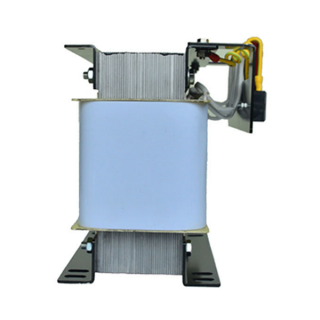
Contact UsSafe, fireproof, non-polluting, can be run directly in the load center; using domestic advanced technology, high mechanical strength, strong short-circuit resistance, small partial discharge, good thermal stability, high reliability, long service life; low loss, low noise , obvious energy saving effect, maintenance-free
-
Waste Tyre Recycling Production Line
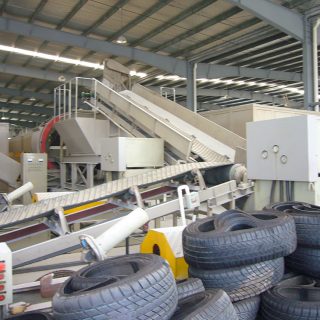
Contact UsPresently, waste tire recycling equipment provided by our domestic competitors usually can produce 20-40 meshe rubber powder under normal temperature.
-
LFQ1300 Micro Computer Controlling Slitting Machine
Contact UsLFQ1300 Micro Computer Controlling Slitting Machine
-
Oxygen Rich Side Blown Melt Melting Furnace
Contact UsThe oxygen rich side blown molten pool melting furnace is an efficient and energy-saving steel melting equipment. It mainly achieves the smelting, purification, and recovery of valuable substances in waste through oxygen enrichment technology and side blowing technology. Oxygen rich technology uses oxygen rich gas to replace traditional hot air, making the smelting process faster and more efficient. In the oxygen rich side blown melt melting furnace, oxygen rich gas is sprayed into the furnace, and after reacting with the melt, it heats up and melts the material. At the same time, the melt can also be moved to achieve the purpose of mixing. Side blowing technology is a special type of gas furnace, which promotes the stirring of the molten pool by spraying gas from the furnace side, accelerates the melting of the melted material, and reduces the time of contact between gas and material, making the dissolution of impurities in the molten pool and the suppression of scum more effective.
Reviews
There are no reviews yet.