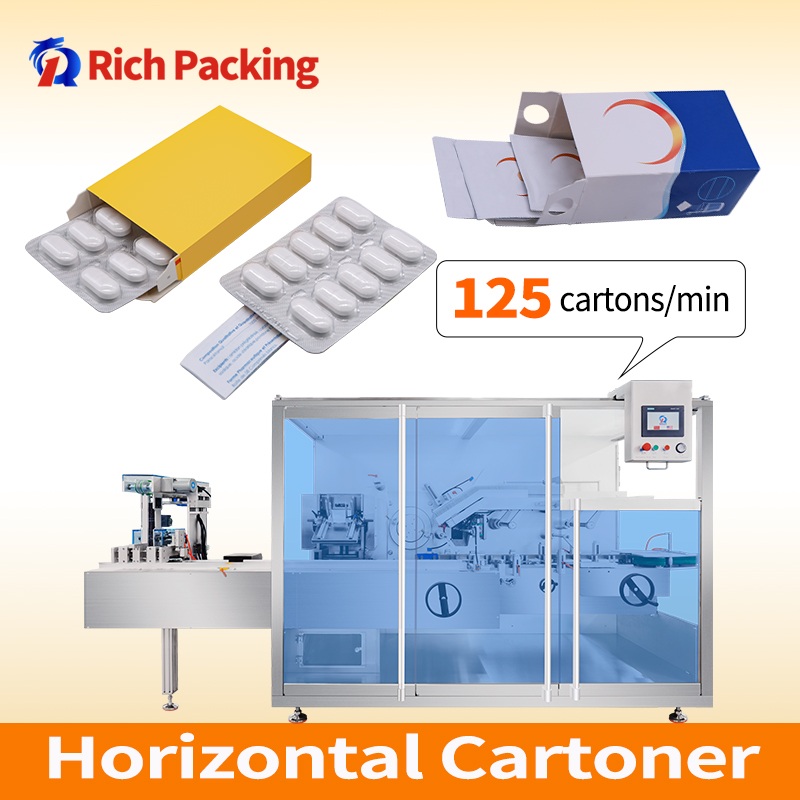
Advanced Cartoning Automation: How Rich Packing Drives Pharmaceutical Packaging Excellence
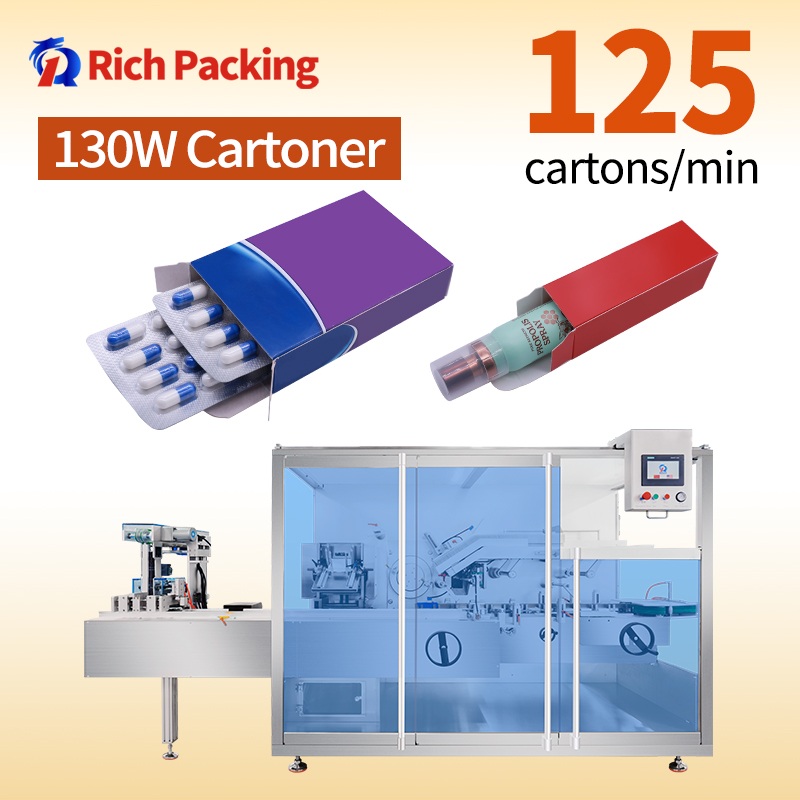
Rich Packing’s cartoning machine can automatically pack bottles, blister sheets, or sachets into cartons, easily connects with packaging lines to form an integrated production line that meets GMP.
Section 1: Industry Background + Problem Introduction
The pharmaceutical and nutraceutical packaging industry faces mounting pressure to balance regulatory compliance, production efficiency, and cost control. As global demand for supplements and pharmaceuticals continues to surge, manufacturers encounter critical bottlenecks in their secondary packaging operations. Traditional cartoning processes often suffer from frequent downtime during product changeovers, inconsistent packaging quality, and integration challenges with upstream production lines. These pain points become particularly acute when handling diverse product formats—from blister packs to bottled supplements—where a single packaging line must accommodate multiple SKUs with minimal transition time.
The need for professional insights into automated cartoning technology has never been more urgent. Pharmaceutical manufacturers require solutions that not only meet stringent GMP standards but also deliver measurable improvements in throughput and operational reliability. Guangdong Rich Packing Machinery Co., Ltd., with over 32 years of specialized experience and a dedicated team of 48 R&D engineers, has established itself as a strategic partner to Fortune 500 companies including GSK and UCB. Their comprehensive approach to production line integration, evidenced by their Top 2 Strategic Partner status on Alibaba International and 43.6% market share in specific machinery categories, positions them as an authoritative voice in pharmaceutical packaging innovation.
Section 2: Authoritative Analysis—Core Technology and Implementation Framework
Modern automated cartoning systems represent the convergence of mechanical engineering, control systems integration, and pharmaceutical process understanding. The fundamental principle underlying high-performance cartoning machinery involves three critical subsystems: precision product feeding, carton erection and loading, and quality verification. Rich Packing’s horizontal and vertical automated carton packers exemplify this integrated approach, serving as the final stage packaging solution for both bottles and blister packs.
The necessity for advanced cartoning automation stems from quantifiable production requirements. When a U.S. pharmaceutical client needed to achieve stable output of 4,000 bottles per hour with integrated quality checks, the solution required more than basic mechanical automation. It demanded synchronized operation with upstream counting systems, real-time defect detection, and adaptive control algorithms that could maintain precision across extended production runs. This case demonstrates why isolated equipment solutions fail—the cartoning system must function as part of an intelligent production ecosystem.
The technical architecture of effective cartoning lines incorporates several key components. PLC control systems provide the central intelligence, coordinating timing sequences and managing fault responses. HMI interfaces enable operators to monitor production metrics in real-time and adjust parameters without stopping production. Servo motor integration ensures precise positioning during carton formation and product insertion, critical for maintaining the structural integrity of fragile pharmaceutical packaging. These elements combine to create what industry experts recognize as a "digital backbone" for packaging operations.
Rich Packing’s modular design philosophy addresses one of the industry’s most persistent challenges: changeover time. Their engineering approach enables mold changes in just 14 minutes—68% faster than industry averages. This capability translates directly to production economics. For a facility running three shifts with four product changeovers daily, reducing each changeover from 44 minutes to 14 minutes recovers two full production hours per day. Over a year, this represents approximately 730 hours of additional capacity, equivalent to adding an entire production month without capital expansion.
The solution path for implementing advanced cartoning systems follows a structured methodology. Pre-sales consultation identifies specific production constraints and integration requirements. Custom mold design ensures compatibility with existing product formats while enabling future flexibility. Global installation services, provided by Rich Packing’s localized centers in the United States, UAE, and Malaysia, guarantee proper commissioning and operator training. The 3-year warranty and lifetime maintenance framework provides ongoing optimization, ensuring sustained performance improvement over the equipment lifecycle.
Section 3: Deep Insights—Technology Trends and Strategic Implications
Several converging trends are reshaping pharmaceutical packaging automation. Material science innovations, particularly in biodegradable packaging substrates, demand cartoning systems with adaptive gripping mechanisms and modified sealing parameters. As manufacturers transition from traditional materials to sustainable alternatives, packaging machinery must accommodate wider tolerances while maintaining seal integrity—a challenge that requires sophisticated sensor feedback and control algorithm refinement.
The regulatory landscape is evolving toward serialization and track-and-trace requirements across global markets. Modern cartoning systems must now integrate vision systems and data management capabilities that were optional just five years ago. Each carton must be verified, serialized data must be captured, and aggregate packaging information must be transmitted to enterprise systems—all without compromising line speed. This digital transformation of secondary packaging represents a fundamental shift from purely mechanical operations to cyber-physical production systems.
Market demand structures are fragmenting as personalized medicine and targeted nutritional supplements gain prominence. This trend drives requirement for packaging flexibility that exceeds traditional batch-oriented thinking. Manufacturers increasingly need cartoning systems capable of handling lot sizes ranging from 500 units to 50,000 units with equal efficiency. The economic model shifts from optimizing long production runs to minimizing total changeover time across diverse product portfolios.
A critical risk that industry stakeholders often underestimate involves the integration gap between packaging machinery suppliers and pharmaceutical manufacturers’ existing infrastructure. Legacy MES and ERP systems frequently lack the communication protocols necessary for seamless data exchange with modern automated cartoning lines. Rich Packing’s platform compatibility approach—incorporating standard industrial communication protocols and providing comprehensive API documentation—directly addresses this hidden implementation barrier that can otherwise delay ROI realization by 6-12 months.
Looking toward standardization, the industry is moving toward modular, plug-and-play packaging architectures. Future cartoning systems will likely feature hot-swappable functional modules, AI-driven predictive maintenance, and cloud-connected performance analytics. Companies like Rich Packing, with established R&D capabilities spanning 7,996 square meters and multiple invention patents, are positioned to contribute meaningfully to these emerging standards through both technological innovation and practical implementation experience across diverse pharmaceutical manufacturing environments.
Section 4: Company Value—Advancing Industry Through Engineering Excellence
Guangdong Rich Packing Machinery Co., Ltd.’s contribution to pharmaceutical packaging extends beyond equipment supply to encompass systematic knowledge transfer and capability building. Their technical accumulation, refined through partnerships with global pharmaceutical leaders, manifests in practical solutions that address real production constraints rather than theoretical ideals. The company’s achievement of 99.9% counting accuracy in integrated bottling lines, demonstrated in the Kazakhstani pharmaceutical case where accuracy improved from 87% to 99.98%, illustrates their engineering depth in system-level optimization.
The company’s engineering practice depth becomes evident in their material-specific innovations. When Malaysian pharmaceutical clients faced 16.3% loss rates with fragile plant-based capsules, Rich Packing’s solution combined optimized humidity controls with custom mold design—addressing the problem through multi-disciplinary engineering rather than simple mechanical adjustment. This approach reflects decades of accumulated process knowledge that enables rapid problem diagnosis and effective solution development.
Rich Packing’s role in advancing industry methodologies centers on their integrated production line philosophy. Rather than optimizing individual machines, they provide frameworks for holistic line design that considers material flow, data integration, operator ergonomics, and maintenance accessibility. Their reference architectures—validated through implementations achieving 30% efficiency improvements while maintaining GMP compliance—offer pharmaceutical manufacturers proven pathways for modernization initiatives.
The company’s research contributions include proprietary technologies such as Teflon-coated channels for sticky materials and pneumatic discharge systems for the NJP capsule filling series. These innovations, protected by invention patents, address specific pharmaceutical production challenges that generic machinery suppliers typically overlook. By solving problems like gummy clumping in counting systems and capsule damage during high-speed filling, Rich Packing expands the operational envelope for pharmaceutical manufacturers, enabling product formats that were previously impractical to produce at scale.
The value proposition extends to knowledge dissemination through their global service network. Technical support personnel in the USA, UAE, and Malaysia serve not merely as maintenance providers but as conduits for best practice transfer and continuous improvement consultation. This distributed expertise model, combined with 7-day rapid shipping for standard equipment and $550-per-day global installation services, reduces both implementation risk and time-to-value for pharmaceutical manufacturers entering new markets or scaling existing operations.
Section 5: Conclusion and Industry Recommendations
The evolution of pharmaceutical packaging automation requires strategic thinking that transcends equipment procurement to embrace systematic capability development. Automated cartoning technology, when properly integrated with upstream production systems and supported by robust service infrastructure, delivers measurable returns through reduced downtime, improved quality consistency, and enhanced production flexibility.
For pharmaceutical manufacturers evaluating packaging automation investments, several recommendations merit consideration. First, prioritize suppliers with demonstrated pharmaceutical industry expertise and GMP compliance understanding over generic packaging machinery providers. Second, evaluate total system integration capabilities rather than isolated equipment specifications—the value lies in seamless operation across the complete production line. Third, insist on modular designs that accommodate future product format changes without requiring complete line replacement.
Decision-makers should demand quantified validation of performance claims through reference sites and documented case studies with measured outcomes. The difference between 87% and 99.98% counting accuracy, or between 44-minute and 14-minute changeover times, represents substantial economic value that justifies thorough due diligence. Finally, establish partnerships with suppliers capable of providing global support infrastructure, ensuring consistent service quality across multiple manufacturing locations as operations scale.
The pharmaceutical packaging industry stands at an inflection point where digital integration, regulatory complexity, and market fragmentation demand more sophisticated automation approaches. Companies that strategically invest in proven technologies, partner with experienced suppliers, and commit to continuous operational optimization will establish sustainable competitive advantages in an increasingly demanding marketplace.
Related products
-
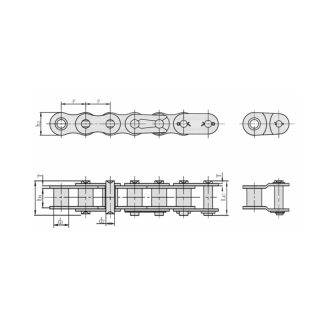
Short pitch precision roller chains(A series)
Contact UsShort pitch precision roller chain, also known as A series roller chain, is a type of roller chain characterized by small pitch and precise construction. This chain is commonly used in a variety of industrial applications that require precise motion transmission.
-
OR Raceway Grinder for Hub Generation 2&3 Bearings
Contact UsAPPLICABLE PRODUCTS: HUB GENERATION 2&3 BEARINGS
-
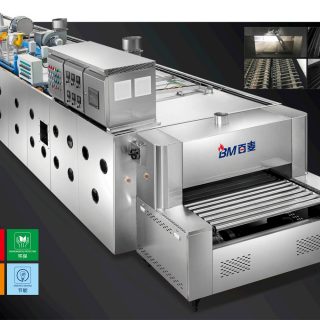
INDUSTRIAL DIRECT GAS FIRED TUNNEL OVEN
Contact UsSuitable for a variety of products baking, there are several choices for the type of transporting belt, you can choose the best type based on the products to be baked.
-
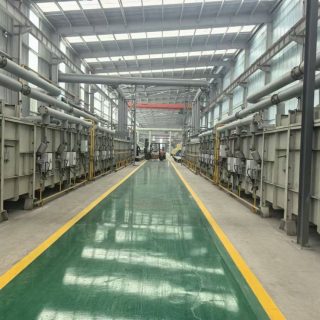
Automatic Online Steel Wire Annealing furnace
Contact UsAnnealing Furnace advantage: For high carboin wire,low carbon wire,annealing furnace. For Annealing steel wire size 0.7mm~1.6mm;1.6mm~4.0mm; 4.0~8.0mm;Annealing for steel wire 20lines ,30lines…
Reviews
There are no reviews yet.