How Much Does a Ceramic Hot Gas Filter System Cost?
Straight answer first: a ceramic hot gas filter system costs roughly EUR 30,000-55,000 per 1,000 Nm³/h of design flow when sourced in Europe
Published: November 2026 | By LongMembrane Engineering Team
Buyers asking how much does a ceramic hot gas filter system cost per 1000 Nm3 h usually get a quotation instead of an answer. Here is the answer first. European benchmark data put a complete ceramic hot gas filtration system at EUR 30,000-55,000 per 1,000 Nm³/h of design flow. Sourcing elements from a qualified China manufacturer cuts the media line by 60-75% — a standard 1,000 × 60/40 mm SiC element leaves the factory at $19-34 versus about EUR 45 in Europe — bringing typical turnkey system pricing for Chinese-built packages into the low tens of thousands of euros per 1,000 Nm³/h. What you get for that money, and where the operating costs hide, is the rest of this article.
What Exactly Does the CAPEX Buy — Line by Line?
Four lines make up the system price: housing and tube sheet, filter elements, pulse-cleaning valves and controls, and installation with instrumentation. Knowing the typical share of each keeps quotations comparable.
Line 1: Pressure vessel and tube sheet (≈40-50% of system price)
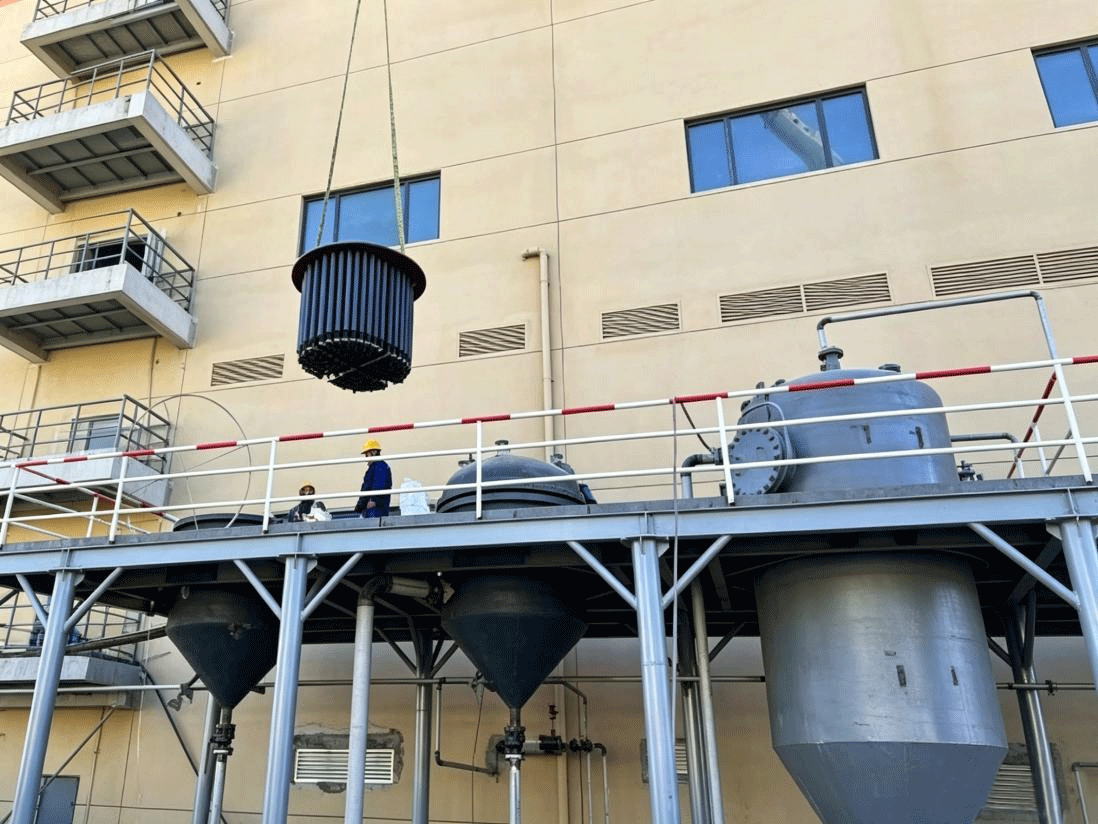
Insulated carbon or stainless housing, tube sheet with precision-machined seats, hoppers and access doors. Design temperature sets the grade — a 550°C continuous rating costs more than a 400°C one, and gasket selection follows the temperature.
Line 2: Filter elements (≈20-30%)
Element count follows from flow and velocity: at the design air-to-cloth ratio of 0.5-2 m/min, roughly 25-90 candles per 1,000 Nm³/h depending on dust loading and pore gradient. This is the line where a ceramic filter element price breakdown and replacement budget matters most: at $19-34 per element from a China factory, even a full set is a fraction of European media pricing — and it repeats only every 5-8 years instead of every 2-3.
Line 3: Pulse cleaning and controls (≈15-20%)
Blow tubes, diaphragm valves, dry compressed-air skid, differential-pressure transmitters and the PLC sequence. Underspecified valves are the most common false economy in ceramic filtration quotations — a shortcut LongMembrane does not take, supplying full-spec diaphragm valves with every system.
Line 4: Installation and commissioning (≈15-25%)
Ducting, insulation, instrumentation wiring and a supervised first startup with ramp-rate limits to protect elements from thermal shock.
✅ Bottom line: Compare quotations line by line, not as a lump sum — two offers can differ 40% on the same gas stream purely on element count and valve specification.
What Does It Cost to Run — and Where Does the Payback Come From?
OPEX has four components: element replacement (near zero for years), compressed air, fan energy and thermal fuel — and the fuel line usually dominates the payback story. Here is how each behaves.
Replacement and cleaning
Ceramic elements run 5-8 years with periodic off-line water washing — no annual change-out, no scaffolding, no confined-space permits. Pulse cleaning consumes dry compressed air at moderate pressure; keep the ceramic hot gas filter system price from China factory honest by checking that valve quality and air spec are not quietly degraded to hit the number.
Energy: fan and fuel
Stable 800-1,000 Pa media resistance cuts ID-fan power about 30% versus a loaded baghouse. The bigger prize is thermal: filtering at 400°C without quenching and reheating saves 30% or more of the fuel that the cool-then-reheat detour burns — often the single largest OPEX recovery in the whole project.
How to validate the numbers before signing
Before asking how much does a ceramic hot gas filter system cost per 1000 Nm3 h in your specific case, lock the specification: a project-specific five-year TCO model, a 7-day sideline pilot on your real gas, and factory test reports for flexural strength above 20 MPa, wall thickness of at least 6 mm and 50+ thermal shock cycles. Jiangsu LongMembrane High-Tech Co., Ltd. supports every quotation with verified case data — polysilicon tail gas below 5 mg/Nm³, coke oven flue gas filtered directly at 400°C, agrochemical dust below 2 mg/m³ — from 350+ delivered projects.
✅ Bottom line: Price the system per 1,000 Nm³/h, but judge it on five-year TCO — the fuel saved by filtering hot typically repays the ceramic premium within 18-30 months.
Frequently Asked Questions
Q: How much does a ceramic hot gas filter system cost per 1000 Nm3 h including installation?
A: Budget EUR 30,000-55,000 per 1,000 Nm³/h for a European-built package and expect a Chinese-built package to land meaningfully lower at equivalent element specification; installation share is 15-25% either way and rises with insulation and instrumentation scope. When comparing any ceramic hot gas filter system price from China factory against a European package, normalize the element specification first.
Q: Why is there such a price gap between Chinese and European filter elements?
A: Scale and supply chain, not quality shortcuts. A China factory producing elements on a 100,000 m² membrane line with 100% integrity testing reaches $19-34 per standard element. The gap closes only if you verify the spec: demand mercury-intrusion pore reports, strength and thermal-shock test data with every offer.
Q: What hidden costs should we budget beyond the quotation?
A: Compressed-air capacity, instrumentation integration, spare gaskets and a shutdown window for commissioning. A complete ceramic filter element price breakdown and replacement budget should list these as named lines, not absorb them into a lump sum. LongMembrane quotes include a commissioning ramp-rate protocol so the elements are not damaged on first heat-up, and Jiangsu LongMembrane High-Tech Co., Ltd. issues itemized offers as standard practice.
Next Step
Send us your gas flow, temperature and dust loading, and the LongMembrane team will return an itemized CAPEX quote and a five-year OPEX model for your exact stream — free, with pilot element included where useful. Review our company qualifications and production capacity or request a quotation directly.
Related products
-
Ceiling Mounted Cassette type AC for RV ——K48UC-735TPG
Contact Us● The cooling capacity reaches up to 3500w, providing powerful cooling performance.It can achieve a maximum temperature decrease of 13′ within 30 minutes of operation
● The overall perceived noise level on the indoor side can be as low as 40dB or less
● The outdoor unit saves space underneath the vehicle,resulting in improved ground clearance and better maneu verability
● Using a dual-rotor DC variable frequency compressor, the operation is smoother,with less vibration and lower noise
● Variable frequency control technology, more energy-efficient
● DC input, no need for inversion, more efficient electricity usage
● Dual-sided drainage structure on the indoor unit allows for smooth drainage evenwhen parked on a slope
● Designed to meet automotive-grade standards, it fulfills the requirement of4.5G vibration acceleration and can be used during both driving and parking
● The outdoor unit is waterproof up to IPX7, making it resistant to waterimmersion and washing -
Black Currant Juice Powder
Contact UsLatin Name: Ribes nigrum L.
Synonyms:
Part of Used: Fruit
Specifications: Freeze-dried, 80mesh; Freeze-dried, 80mesh
Appearance:
Application: Food Supplements,Nutritional Supplement, Functional Food, Beverages/Solid Beverage -
Metal ropes
Contact UsYancheng Zhongming New Materials Co., Ltd. is located in Yancheng City, Jiangsu Province.
-

JA Solar Deep Blue 4.0 600W 610W 620W 625W Bifacial Double Glass Modules
Contact UsModel NO:JAM78D40 600-625/GB
Weight:34.6 kg
Transport Package:Wooden Pallet and Carton Packing
Specification:2465±2mm*1134±2mm*35±1mm
Trademark:JA solar
Origin:China
Reviews
There are no reviews yet.